In the summer of 1952, a former Harrow schoolmaster called Christopher Strachey got a program running on the Ferranti Mark 1 at the University of Manchester. It played draughts. By his own account it could manage "a complete game of Draughts at a reasonable speed". Strachey had known Alan Turing at King's College, Cambridge, and had written to him for the machine's programming manual. That same summer he set the computer generating love letters too, now regarded as the first example of computer-generated literature. The machine filled a room. Elizabeth II had not yet been crowned.
So when someone tells you AI arrived in November 2022, they're roughly seventy years late. What arrived in November 2022 was a chat window. The intelligence, or whatever we eventually agree to call it, had been in development since before most of any senior leadership team was born.
This matters, because people who think AI is new tend to think it's magic, and people who think it's magic tend either to worship it or to panic. Neither is a strategy. History is the antidote, and it's far simpler than the jargon suggests. It comes in five stages: the dream, the rulebook, the learner, the predictor and the agent. Underneath all five sits an engine room that rarely gets the credit.
Running through the whole story is one uncomfortable idea. For most of its life, AI failed because we tried to tell machines what we know. It started working when we gave up.
The dream
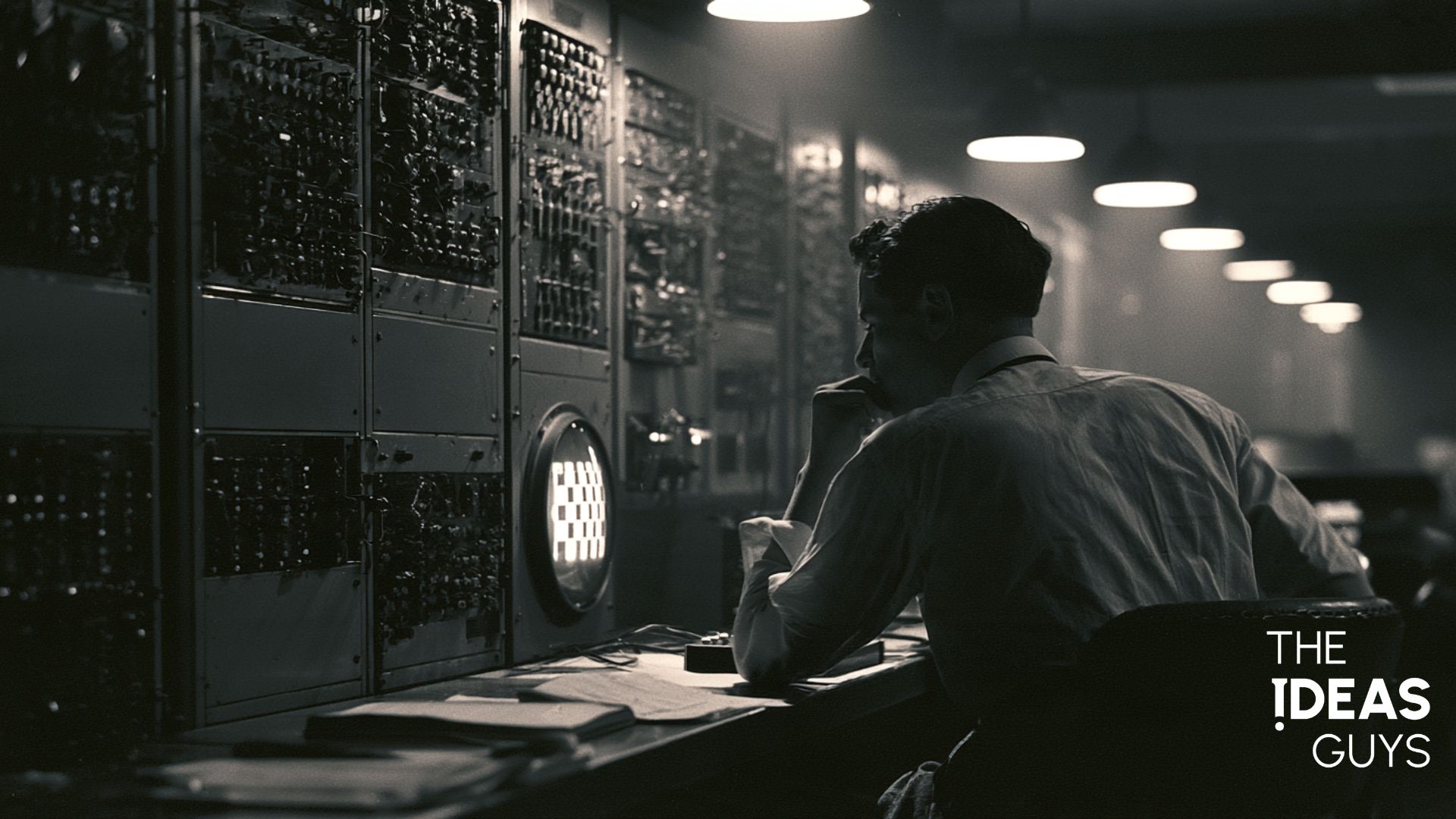
The story begins nearly two centuries ago, with a translation. In 1843 Ada Lovelace translated a paper by the Italian engineer Luigi Menabrea on Charles Babbage's Analytical Engine, a steam-age computer that was never built. She added notes of her own that ran to roughly three times the length of the original. The last of them, Note G, set out step by step how the engine could calculate a sequence called the Bernoulli numbers. It's widely regarded as the first published computer program, written for a machine that didn't exist.
Lovelace saw further than Babbage did. She grasped that a machine manipulating numbers could manipulate anything those numbers stood for, music included. But she also kept a firm hand on her own excitement.
"The Analytical Engine has no pretensions whatever to originate anything." Ada Lovelace
It could do whatever we knew how to order it to perform, and nothing more.
A little over a century later, Alan Turing, by then working on Manchester's computers, picked a fight with her. His 1950 paper, Computing Machinery and Intelligence in the journal Mind opens with what is still the best one-line summary of the entire field.
"I propose to consider the question, 'Can machines think?'" Alan Turing
Turing promptly declared the question too vague to answer and swapped it for a test he called the imitation game. If a machine can hold a conversation you can't tell apart from a person's, on what principled grounds do you deny that it thinks? He then worked through the objections one at a time, and gave one of them a name. "Lady Lovelace's objection" was the claim that machines only ever do what they're told. Turing didn't buy it. He argued that machines could be built to learn, and that a learning machine would surprise the people who made it.
And this leads me to a cheeky little provocation. Every staffroom argument about whether ChatGPT is "really creative" or "just remixing" is Lovelace versus Turing, almost word for word, nearly 180 years on. (I made the case for why that argument matters in Why Everyone Needs to Grapple with the AI Revolution, so I won't rerun it here.) The point for now is simpler. The question came first. The machines spent the next seventy years catching up with it.
The rulebook
The field got its name in 1955, in a funding bid. John McCarthy, Marvin Minsky, Nathaniel Rochester and Claude Shannon asked the Rockefeller Foundation to pay for a two-month, ten-man study at Dartmouth College the following summer. Their bid rested on a conjecture that "every aspect of learning or any other feature of intelligence" could be described so precisely that a machine could simulate it. A carefully chosen group, they suggested, could make real progress in a single summer. (Ten men. One summer. Hold that thought.)
That conjecture shaped the next thirty years. If intelligence could be described, the job was simply to write the description down. Researchers built systems of rules and symbols. If the patient has a fever and a rash, consider measles. If the bishop is under threat, move it. By the 1980s these "expert systems" were being sold to businesses as bottled expertise. In tidy, closed worlds with clear rules, such as logic puzzles and board games, the approach could be genuinely impressive.
Out in the messy world, it struggled, and Britain was the first to say so out loud. In 1973, the Science Research Council published a review of the field by the Cambridge mathematician Sir James Lighthill, who was not an AI researcher himself. He concluded that AI had failed to achieve its "grandiose objectives". The BBC broadcast a debate in which Lighthill defended his report against three of the field's leading figures, including McCarthy himself and Edinburgh's Donald Michie. The researchers may have won the argument in the studio, but they lost the one that mattered. Funding for basic AI research in Britain dried up quickly, and Edinburgh, one of the country's earliest and biggest AI centres, felt it hardest. The first AI winter had arrived, and it started here.
Lighthill was harsh, but he had spotted something real about the rulebook. The philosopher Michael Polanyi, a Hungarian-born chemist who spent much of his career at Manchester, had already explained why it would hit a wall.
"We can know more than we can tell." Michael Polanyi
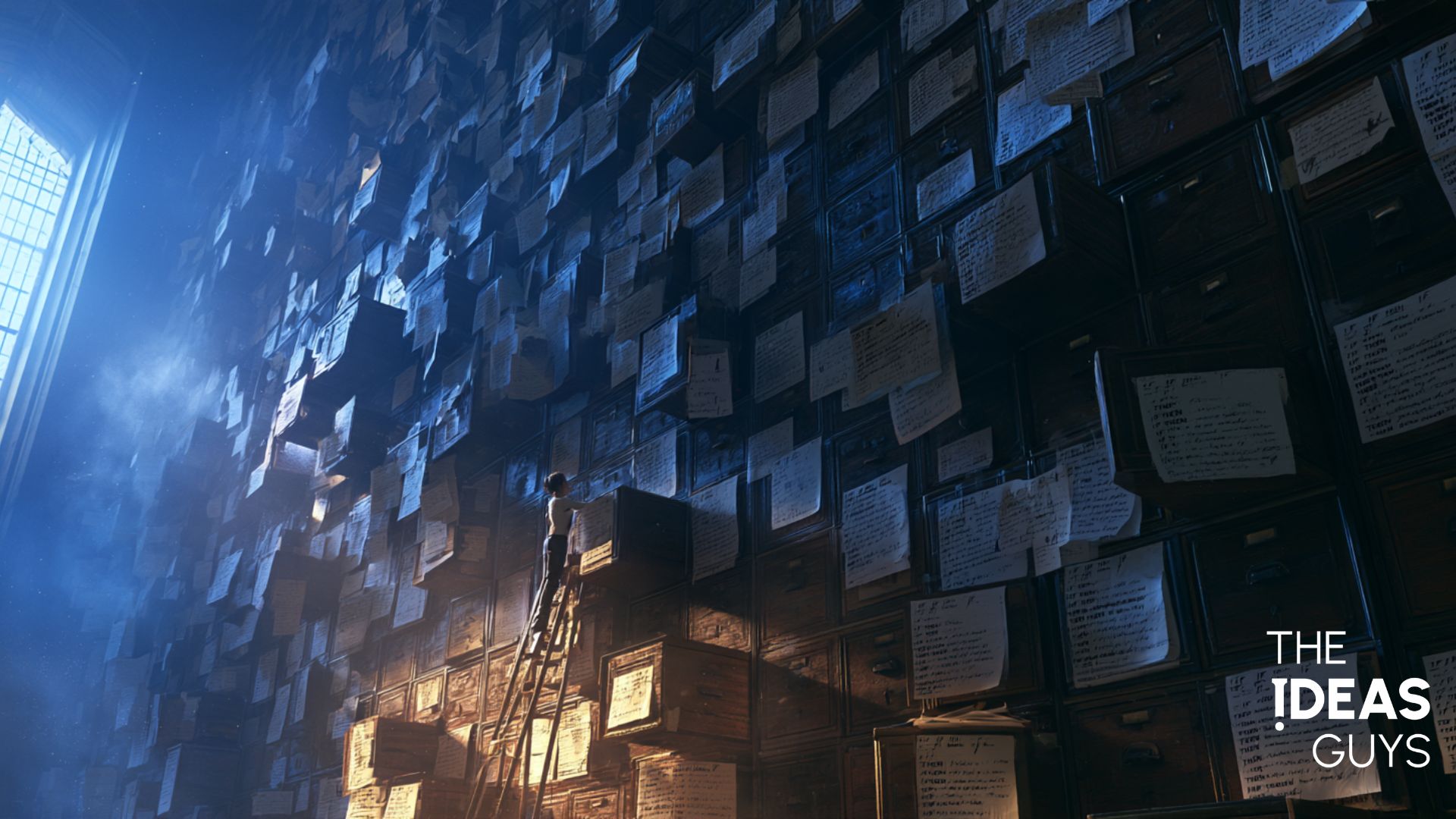
His favourite example was a face. You can pick a friend out of a crowd of thousands, yet you couldn't write down the rules you used to do it. Most of what we know works like that: riding a bike, reading a room, sensing that a Year 9 class is about thirty seconds from turning. It's tacit, and tacit knowledge doesn't fit in a rulebook, because if you could write it down it wouldn't be tacit. The rulebook approach could only ever capture the visible tip of intelligence, the part we're able to say out loud.
The learner
If you can't write the rules down, there's another option. Let the machine work them out from examples. That idea is older than the rulebook, and it came from psychology. In 1949, the Canadian psychologist Donald Hebb proposed that learning happens when connections between brain cells strengthen through use. When one cell repeatedly helps another to fire, the link between them grows. The catchy version, "cells that fire together wire together", wasn't actually Hebb's. It came from the neuroscientist Carla Shatz in 1992, which tells you something about how long good ideas can wait for a good slogan (as per another article I have written, The Half-Quote That Ate the Whole Idea.)
An artificial neural network borrows Hebb's idea, very loosely. Think of thousands, then millions, then billions of dimmer switches, each wired to others. Show the network a photograph and let it guess "cat". Tell it whether it was right, then nudge every switch slightly in whichever direction would have made the answer better. Repeat a few million times. Nobody writes a rule about whiskers. The rules, if that's even the right word, end up smeared across the settings of the switches.
The man who kept this idea alive through decades of scepticism was British. Geoffrey Hinton was born in Wimbledon, read experimental psychology at Cambridge, spent a year as a carpenter, then took a PhD in artificial intelligence at Edinburgh, completing it in 1978 in a city still nursing Lighthill's bruises. His supervisor, Christopher Longuet-Higgins, favoured the rulebook over neural networks. Hinton later described it as "a stormy graduate career". Unable to find funding at home, he left for the United States and later Canada. In 2024, he shared the Nobel Prize in Physics for the very work Britain had been unwilling to pay for. The godfather of modern AI is, in other words, a British export we didn't realise we were exporting.
The challenge facing the learners had been neatly named by the roboticist Hans Moravec in 1988. Computers found the "hard" things easy and the "easy" things nearly impossible. Getting adult-level performance on intelligence tests or draughts was comparatively simple, he observed, but it was "difficult or impossible to give them the skills of a one-year-old" when it came to perception and movement. Chess is a closed world. Spotting a cat in bad lighting is not.
Then came 2012. Alex Krizhevsky and Ilya Sutskever, both students of Hinton's at the University of Toronto, entered a neural network called AlexNet into ImageNet, an annual competition to identify objects across more than a million photographs. It achieved a top-five error rate of 15.3%. The runner-up managed 26.2%. In a field that usually crept forward by fractions of a percent, it was a landslide. And it was trained over five or six days on two Nvidia GTX 580 graphics cards, which is to say gaming hardware, in Krizhevsky's bedroom at his parents' house.
The modern AI era did not begin in a government laboratory. It began on kit designed for video games. (I find that enormously cheering, and I suspect a lot of teenagers would too, especially those whose parents tell them playing games will never amount to anything!)
The paper's authors added a line that turned out to be prophetic. Their results, they suggested, could probably be improved simply by waiting for faster graphics chips and bigger datasets. Hold onto that. It's the key to the engine room.

The predictor
Five years after AlexNet, eight researchers at Google published a paper with a cheeky title, Attention Is All You Need, a nod to the Beatles. It introduced the transformer, the "T" in ChatGPT.
The idea is easier to grasp than its reputation suggests. Older systems read a sentence one word at a time, like someone reading through a keyhole. A transformer takes in the whole passage at once and works out which words matter to which. In "the head teacher praised the pupil because she had worked so hard", it learns to weigh up who "she" is likely to be. Crucially, that design suited exactly the hardware AlexNet had made fashionable: chips that do thousands of small sums at the same time.
If you feed a transformer an enormous slice of the written internet and train it on one deceptively simple task, predicting the next word, and something odd happens. To predict the next word well across that much text, it has to absorb grammar, facts, styles of argument and patterns of reasoning. Nobody programs any of that in. It's a side effect of getting very good at guessing.
That's my honest one-line explanation of a large language model. It's autocomplete that has read more than any human ever will. That makes it less than the hype suggests, because it's predicting rather than consulting some inner oracle. It also makes it more than the sceptics admit, because prediction at that scale turns out to do a startling amount of what we used to call thinking.
OpenAI released ChatGPT as a free research preview on 30 November 2022. By January it had an estimated 100 million monthly users, according to analysts at UBS, the fastest growth of any consumer app on record at the time. Seventy years of research looked, from the outside, like an overnight success.
There's a philosophical sting here too. In The Grammar of Reality I leaned on Wittgenstein's argument that the meaning of a word lies in how it's used, rather than in some definition sitting behind it. Large language models learned language from use alone, with no dictionary and no experience of the world the words describe. Whether that vindicates Wittgenstein or parodies him is, I think, one of the better arguments you could have in a sixth form philosophy lesson!
The agent
The newest stage is the quickest to explain (and possibly the hardest to understand!). A predictor answers. An agent acts. Give a language model access to tools, such as a browser, a calendar or a code editor, along with permission to take several steps on its own, and it stops being something you consult and becomes something you delegate to. Booking, drafting, checking, fixing, chasing.
Technically, this is less a new invention than the predictor with hands. That's exactly why it matters. The questions shift from "is the answer right?" to "who's responsible when it does the wrong thing?" I've written about the move from tool to agent in Why Everyone Needs to Grapple with the AI Revolution, and about why the person using it matters more than the platform in Equip the Operator, so I'll leave that argument there and go somewhere the AI conversation rarely does. Underneath.
The engine room
Every stage of this story has a software hero. The heavy lifting was done by hardware.
In 1965, Gordon Moore, then running research and development at Fairchild Semiconductor, wrote a short magazine article predicting that the number of components on a chip would double every year. In 1975, with the prediction holding, he revised it to every two years. (The "every eighteen months" you'll often hear actually came from his Intel colleague David House, which makes Moore's law one of technology's most famous misquotes.) For half a century it held, and it made Moore an optimist.
"Moore's law is a violation of Murphy's law. Everything gets better and better." Gordon Moore
The trouble is that everything stopped getting better for free. By the mid-2000s, shrinking transistors no longer brought the automatic gains in speed and power efficiency it once had (engineers call the end of this "Dennard scaling"), and the cost of building each new generation of chip factory kept climbing. Chips still improve, but the free lunch is over.
So AI found another way to grow. Not faster chips, but far more of them. Graphics processors that perform thousands of sums at once, wired together in data centres the size of small towns. That's how a company that spent decades selling to gamers ended up at the centre of the AI economy.
Rich Sutton, a pioneer of reinforcement learning, named this pattern "The Bitter Lesson" in 2019. Looking back over seventy years of AI research, he argued that general methods which make use of ever more computation have repeatedly beaten clever attempts to build human knowledge into machines. Researchers kept trying to teach computers how we think, and kept being overtaken by sheer scale.
"Building in how we think we think does not work in the long run." Rich Sutton
It's Polanyi's point, arriving from the opposite direction.
Britain's part in the engine room will sound familiar. Arm, the Cambridge chip designer whose technology sits inside almost every smartphone on the planet, was bought by Japan's SoftBank in 2016. Graphcore, the Bristol firm once tipped as a rival to Nvidia, followed in 2024, reportedly for less than the roughly $700 million investors had put into it. Lighthill's funding freeze, Hinton's departure, our chip firms sold abroad. Britain has a habit of inventing the future and then selling the lease.
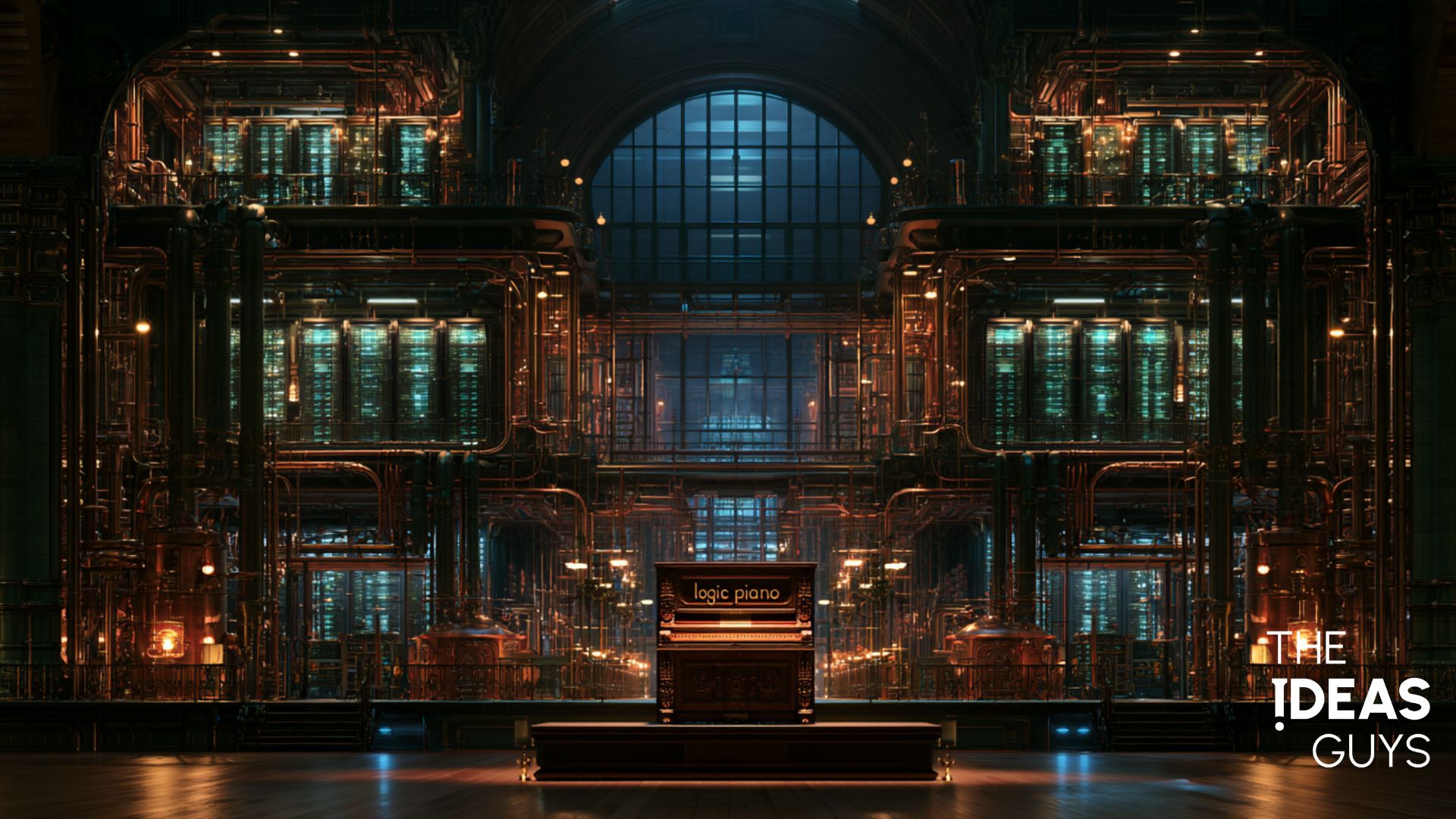
There's an older British ghost in the machine too. William Stanley Jevons, working in Manchester, had a Salford clockmaker build him a "logic piano" in 1869, a device with piano-like keys that could solve problems in logic faster than a person could. It still sits in Oxford's History of Science Museum. Four years earlier, in The Coal Question, Jevons had noticed that more efficient steam engines hadn't reduced Britain's coal consumption. They had increased it, because cheaper power found more uses. Every efficiency gain in AI so far has behaved in exactly the same way. Cheaper computation means more computation, more chips and more electricity. Jevons built one of the first reasoning machines, and he also wrote down the economic law that now haunts its descendants.
Which brings us to quantum, where I'm sceptical but hopeful. Quantum computers exploit the strange physics of very small things, and could in principle tackle problems, such as simulating complex molecules, that would take ordinary computers impractically long. Their curse has always been errors. Qubits are so fragile that adding more of them used to make things worse. In December 2024, Google's Willow chip, with 105 qubits, showed errors falling as the system grew, the long-awaited "below threshold" result. IBM is aiming for large-scale, fault-tolerant quantum machines by 2029.
That's genuine progress. It's also not what powers your chatbot. Useful quantum computing needs vastly more reliable qubits than anyone has today, and a good deal of what you'll read about "quantum AI" is a press release in search of a product. The hopeful version is quieter. If quantum machines do arrive, their first big wins are likely to be in chemistry and materials science, perhaps better batteries or more efficient chips, which would be a rather neat way of paying back some of the energy AI is currently borrowing.
Why the history matters
The futurist Roy Amara gave us one of the most useful sentences in technology forecasting.
"We tend to overestimate the effect of a technology in the short run." Roy Amara
He went on to add that we underestimate it in the long run. AI's history is Amara's law on a loop. Dartmouth's summer optimism, then Lighthill's winter. The expert systems boom of the 1980s, then the collapse of the specialist AI hardware market in 1987 and a second winter. Then AlexNet, then ChatGPT. Each time, the short-term promise outran reality, and the long-term change outran nearly everybody's imagination. Quantum is the live test case: over-sold this year, probably under-rated this decade.
For leaders, that's a discipline rather than a prediction. When a vendor promises transformation by September, remember Dartmouth. When the cynic in the staffroom says it's all hype, remember AlexNet. Both are making the same mistake from opposite ends.
Then there's the sting for education. The clearest lesson of seventy years of AI is that intelligence wouldn't fit in a rulebook. Machines got clever when we stopped scripting them and gave them examples, feedback and repetition instead. In other words, when we treated them more like Hebb said brains learn. Rules turned out to be scaffolding, not the building.
So how much of school improvement still assumes good teaching can be fully written down? The tick-box observation form, the lesson template with its mandatory phases, the rubric that tries to pin what excellent work "looks like" into a handful of bullet points. None of these are useless, and plenty of new teachers benefit from a scaffold. But Polanyi would recognise the trap. We keep trying to codify the tacit part of expertise, then wonder why the codified version produces compliance rather than craft. The machines learned this lesson the hard way, at the cost of two winters. We could learn it more cheaply.
There's a simpler, practical point too. Understanding that a language model is a predictor, not an oracle, changes how you use it. A pupil who knows it's guessing the most plausible next word will check where its claims came from. A pupil who thinks it "knows" won't. Teaching the history of AI isn't nostalgia. It's possibly the most efficient piece of AI literacy I know.
Seventy years of overnight success turns out to be a story about humility. The rulebook failed because we overestimated how much of our own intelligence we could explain. The learner succeeded because one stubborn researcher kept faith with an unfashionable idea through two winters and a cold shoulder from his own country. And the engine room reminds us that progress has a physical cost that efficiency alone won't magic away.
The next stage, whether that's agents we can genuinely trust or quantum machines that actually work, will probably arrive the way all the others did: slower than the headlines and faster than the planning. So the question for your organisation isn't whether AI is coming. It's whether, when the next overnight success lands, you'll understand it well enough to tell the promise from the product.
Key takeaways
- For decades AI failed because researchers tried to write intelligence down as rules, and most of what humans know cannot be put into words.
- Modern AI learns from examples and feedback rather than instructions, and a large language model is best understood as an extraordinarily well-read prediction engine, not an oracle.
- The breakthroughs depended on hardware as much as ideas, and with chips no longer getting faster for free, AI now grows by consuming more chips, more data centres and more energy.
- Quantum computing has made genuine progress but isn't powering today's AI, so claims about "quantum AI" deserve healthy scepticism alongside patient hope.
- Every era of AI has been overestimated in the short term and underestimated in the long term, so leaders should resist both the vendor's timeline and the cynic's dismissal.
- Intelligence turned out not to fit in a rulebook, which should make schools wary of reducing great teaching to checklists and templates.
Understanding where AI came from won't tell you exactly where it's going, but it will stop you being surprised by the shape of the journey. If you're planning staff training on AI this year, start with the story, not the tools. People who understand that the machine is predicting will use it more wisely than people who've only been shown which buttons to press
Further Reading
Discover more interesting articles here.