.png)
Trigger warning: discussion around suicidal ideation, mental health and depression
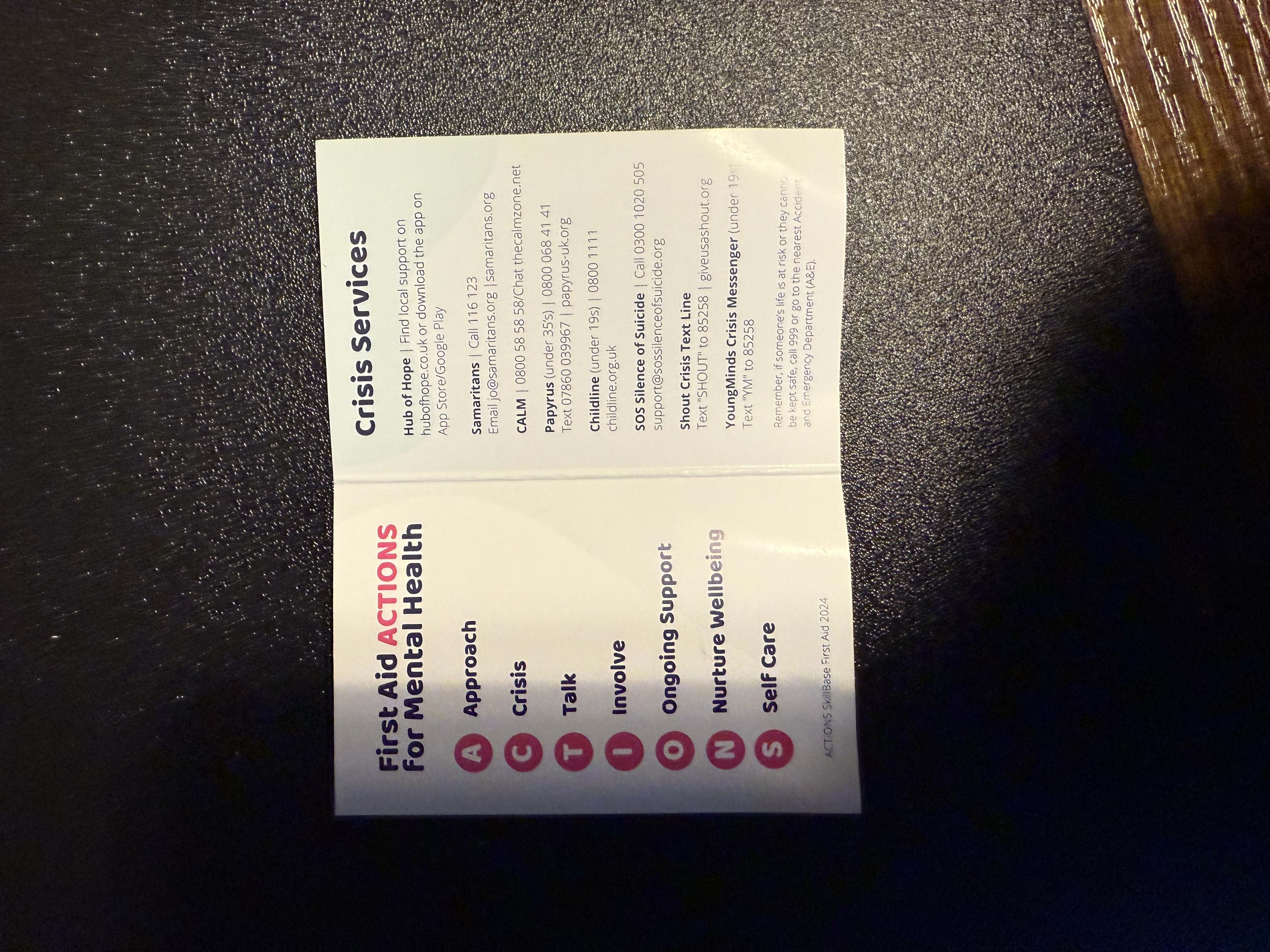
The card sits in my wallet now, slightly bent from being shoved between receipts and my beautifully weird photographic driving licence! On one side, the ACTIONS acronym in reassuring pastel circles. On the other, crisis numbers I hope I'll never need to dial in a panic but am grateful exist. It's a curious artefact from a two-day mental health first aid course - a tangible reminder of something I thought I already understood but clearly didn't.
The irony wasn't lost on me, sitting in that training room. Here I was, someone who's stood on a motorway bridge contemplating jumping, someone who's battled depression and used to take medication for years, someone who's written openly about mental health struggles - being taught how to support others in crisis. The discomfort was palpable, that familiar imposter syndrome whispering: "What are you doing here? You're the one who needs help, not the one who gives it."
But that discomfort, it turns out, was precisely why I needed to be there. Because the most dangerous thing about surviving your own mental health crisis is the conviction that you therefore know how to save everyone else.
The trainer, Tamia Vassallo, is a powerhouse. I'd first met her on one of my digital marketing bootcamps - young, driven, building something meaningful rather than just talking about it. Watching her deliver this training revealed someone who understands that mental health first aid isn't about heroics or grand gestures. It's about showing up, shutting up, and sometimes just holding space for someone else's pain without trying to fix it.
That last bit? That's where I've been getting it catastrophically wrong.
The Fixer's Curse
There's a particular species of helper that emerges from personal crisis. We're the survivors who've crawled out of our own darkness and mistaken our survival for wisdom. We've found what worked for us - therapy, medication, exercise, gratitude journals, whatever combination kept us breathing - and we're absolutely convinced that this formula will work for everyone else.
I am that species. Textbook example.
My mental health history isn't just a backdrop to my life; it's shaped how I approach everyone else's struggles. The bridge episode in 2013, the years of medication, the ongoing work with Ali my counsellor, the recent autism diagnosis I've only just started discussing publicly - all of it has given me a dangerous sense of expertise. Dangerous because it's half true. I do understand certain things about mental health that someone without lived experience might miss. But understanding your own experience doesn't automatically translate into knowing what's right for someone else.
And yet I've spent years operating as if it does.
In my coaching practice, I talk about "helping people think differently." Beautiful, isn't it? Except when you peel back that lovely phrase, what often sits underneath is a more uncomfortable truth: I think I know what they should be thinking instead. I've dressed up fixing in the language of facilitation, wrapped prescriptions in questions, and convinced myself that because I'm not explicitly telling people what to do, I'm not trying to control outcomes.
The mental health first aid course held up a mirror I'd been carefully avoiding. Because when someone you care about is struggling - and there are examples uncomfortably close to home right now - the temptation to fix is overwhelming. When you've been there yourself, when you know the depths of that darkness, every fibre of your being wants to grab them and pull them out using the same methods that saved you.
But that's not how this works. That's not how any of this works.
The ACTIONS Framework: A Different Way
The course introduced ACTIONS as a structured approach to mental health first aid. It's an acronym, which immediately made the cynic in me bristle - we love a good acronym in wellbeing circles, don't we? But strip away the packaging and what remains is surprisingly robust: a framework that prioritises presence over prescription, process over outcome.
Approach is about how you initiate the conversation. Not charging in with solutions or assumptions, but creating an opening that feels safe rather than interrogatory. The course emphasised reading context and timing - recognising when someone might be ready to talk versus when your approach, however well-intentioned, might push them further away.
This landed hard for me. My default is direct confrontation masked as concern: "I can tell something's wrong, talk to me." It comes from a good place - I don't want people to suffer in silence like I did - but it's also controlling. It assumes I have the right to demand access to someone's internal experience. It frames their reluctance to share as a problem to overcome rather than a boundary to respect.
My ADHD brain wants immediate resolution. Sitting with someone's unspoken pain while waiting for them to find their words feels excruciating. But that discomfort is mine to manage, not theirs to relieve by opening up before they're ready.
Crisis focuses on recognition and risk assessment. When is someone in immediate danger versus chronic struggle? When do you need to involve emergency services versus supporting them to access ongoing help? The course provided clear frameworks for assessing suicidality, self-harm risk, and mental health emergencies.
This is where I didn't agree with everything presented. The approach to self-harm, whilst clinically sound and clearly coming from extensive evidence, sat uncomfortably with me. I appreciate why the guidance is structured as it is - there are legal and safeguarding frameworks that need following. But my own understanding of self-harm, both from lived experience and from people I'm close to, is more nuanced than the course materials could accommodate in a two-day training. That's not a criticism of Tamia or the content; it's recognition that any framework will have limitations when applied to the messy reality of human suffering.
But what I took from this section that matters is that I am not a mental health professional. I am someone with lived experience, which gives me empathy and understanding, but it doesn't give me diagnostic capability or treatment authority. My job in a crisis isn't to assess whether someone's self-harm is "serious enough" or to determine their level of risk. My job is to take their distress seriously, keep them safe in the immediate moment, and help them access appropriate professional support.
That distinction might sound obvious, but it's one I've consistently blurred.

Talk seems straightforward until you realise how rarely we actually do it well. The course emphasised open questions, active listening, and resisting the urge to fill silence. It introduced the concept of "looping" - reflecting back what you've heard to check understanding before moving forward.
I wrote about Charles Duhigg's Supercommunicators recently, exploring how effective communication requires matching the type of conversation someone else is having. But what that piece didn't fully address is the challenge when you're not having a conversation at all - when you're conducting an intervention. Because that's what my "helpful talks" often become: interventions disguised as dialogue.
True listening requires surrendering your agenda. It means accepting that someone might talk through their struggle and arrive at a completely different solution than the one you think they need. It means sitting with their pain without rushing to make it stop. For someone whose own mental health was characterised by prolonged suffering that felt unbearable, allowing someone else to remain in that space feels like complicity.
But it's not. It's respect. It's recognition that their pain is theirs to navigate, not mine to remove.
Involve addresses when and how to bring others into support. This includes professional services, but also trusted friends, family members, or community resources. The emphasis was on collaborative decision-making where possible - asking who the person would find helpful rather than deciding for them.
My resistance to this section was immediate and revealing. I want to be the person who helps. I want to be the one they turn to, the one who makes the difference. There's ego wrapped up in that, and probably some trauma too. Being the helper means I'm not the one who needs help. It means I've transcended my own struggles enough to guide others through theirs.
Except that's bollocks, isn't it? The most effective support rarely comes from a single source. One of the people I am close to who's struggling right now needs a whole ecosystem of support - professional help, peer support, family, friends, community. My insistence on being central to their recovery isn't about what's best for them; it's about what makes me feel useful and needed. It’s a reminder that I need to get over myself (and that isn’t easy to hear!)
The course pushed back on heroic individualism in mental health support. It positioned the first aider not as saviour but as connector - someone who helps the person access the right support rather than trying to be all the support themselves. This felt both obvious and revolutionary. Obvious because of course one person can't meet all of someone's needs. Revolutionary because it challenged my deeply held belief that I should be able to.
Ongoing acknowledges that mental health is a marathon, not a sprint. The person who's in crisis today might need support for months or years. The course discussed pacing yourself, managing your own wellbeing as a supporter, and recognising that recovery isn't linear.

This connects directly to my piece about strategic rest (add link). You can't support someone through extended mental health challenges if you're running yourself into the ground. The metaphor about putting on your own oxygen mask first is overused because it's true, but there's a more subtle point here: if you're constantly operating in crisis mode, you lose the capacity for the steady, sustained presence that genuine support requires.
My own mental health journey has been ongoing - nearly twelve years since the bridge, seven years since coming off medication but knowing I'd go back on it if needed, recent autism diagnosis forcing recalibration of how I understand myself. This isn't a story with a neat ending where I "recovered" and now help others. It's an ongoing process of management, understanding, and adaptation.
Recognising this in my own life should make it easier to accept in others'. But somehow it doesn't. I still catch myself thinking "surely by now they should be..." or "if they just did X, then..." The fantasy of the quick fix dies hard, especially when watching someone you care about struggle.
Nurture Wellbeing extends beyond crisis management to proactive mental health support. This includes everything from encouraging healthy sleep and exercise to supporting connection and meaning-making. The course presented this through a social-prescribing lens - recognising that mental health is influenced by employment, housing, community connection, physical health, and a whole ecosystem of factors.
This is where frameworks meet reality and reality often wins. It's all very well to suggest someone exercises more, eats better, or connects with community. But if they're barely functioning, if getting through each day feels like wading through treacle, these suggestions can feel like additional demands rather than supportive ideas.
I think what this section taught me - or tried to teach me, because I'm still learning it - is that nurturing wellbeing isn't about prescribing activities. It's about removing barriers and creating conditions where wellbeing becomes possible. Sometimes that's practical: helping with childcare so someone can attend therapy. Sometimes it's emotional: being the person they don't have to perform wellness for.
.jpg)
Self Care might be the most important letter in the acronym, though it comes last. You cannot pour from an empty cup, you cannot support others if you're drowning yourself, insert whichever metaphor you prefer. The point remains: helper wellbeing directly impacts helping effectiveness.
The course provided frameworks for recognising burnout, setting boundaries, and knowing when to step back. It normalised the reality that supporting someone through mental health challenges is emotionally demanding work, even when that someone is a friend or family member rather than a client or patient.
This challenged my martyr complex directly. I've worn my availability as a badge of honour - the friend who always picks up, the coach who goes over time, the person who'll drop everything in a crisis. But that's not sustainable, and more importantly, it's not actually helpful. When I'm exhausted and resentful, I'm not providing good support. I'm going through the motions whilst my own tank empties.
The permission to say "I can't right now" or "I need to take a break" felt radical. It also felt necessary. Because the truth is, some of the situations close to home right now are affecting my own mental health. Watching people I love struggle triggers my own anxiety and depression. Feeling unable to fix it compounds that distress. And if I'm not careful, I'll end up back in a place where I need the support I'm trying to give.
What I Learned About Myself
The course gave me language for patterns I'd been enacting unconsciously. The fixer role isn't just unhelpful; it's often actively harmful. It infantilises the person struggling by suggesting they can't navigate their own path. It centres my comfort and need to feel useful over their actual needs. And it creates an unhealthy dynamic where they feel pressure to "get better" to reward my efforts.
I catch myself doing this constantly now. In coaching conversations where I'm supposed to be facilitating someone's thinking, I feel the pull toward directing their thinking instead. "Have you considered...?" I'll ask, as if the question just occurred to me, when really I've decided that's exactly what they should be considering and I'm just packaging the prescription as enquiry.
With people close to home who are struggling, I monitor myself falling into patterns. The checking in that's really checking up. The "how are you?" that's really "have you done the thing I think you should do?" The suggestions offered as gentle ideas that are really demands wrapped in concern.
The ACTIONS framework doesn't eliminate these impulses - I don't think anything could. The need to fix is wired deep, probably connected to my own trauma, definitely connected to how helpless I felt during my own worst periods. But the framework gives me something to redirect those impulses toward. Instead of trying to fix, I can focus on approaching well, talking effectively, involving appropriate support, maintaining ongoing presence without overwhelming, nurturing conditions for wellbeing, and ensuring I don't destroy myself in the process.
It's not that I've stopped wanting to fix people. It's that I'm beginning to recognise that desire for what it is: my need, not theirs.
The Coaching Paradox
My work centres on helping people think differently about education, innovation, leadership, whatever challenge they're grappling with. I facilitate workshops, deliver keynotes, run coaching sessions, as many of you know. The positioning is about questions rather than answers, about drawing out insight rather than imposing it.
But the mental health first aid training exposed uncomfortable parallels between fixing and facilitating. Because what is coaching if not a structured attempt to change how someone thinks? The framework might be more sophisticated than "here's what you should do," but the intention often isn't that different.
There's a version of coaching that respects autonomy while providing structure for thinking. The coach as thinking partner, creating space for reflection and insight without attachment to specific outcomes. That's the version I aspire to.
Then there's the version I actually practise more often than I'd like to admit. The coach who's already decided what insight the client needs to arrive at and is carefully steering the conversation toward that conclusion. The coach who gets frustrated when someone doesn't reach the "obvious" realisation. The coach who's less interested in their thinking process and more invested in their reaching the "right" conclusion.
The ACTIONS framework has forced me to confront this more honestly. If I can't sit with someone's mental health struggle without trying to fix it, how effectively am I really sitting with their strategic struggles or leadership challenges? If I'm constantly managing my own discomfort with their uncertainty by pushing toward resolution, whose needs am I serving?
This isn't an existential crisis about my work. I still believe in coaching as valuable practice. But it's a recognition that the fixer tendency doesn't only show up in mental health contexts. It's a pattern that runs through all my attempts to help anyone with anything.
The work now is learning to separate presence from prescription. To offer frameworks and questions and space without sneaking in my agenda for what they should do with those gifts. To trust that people are capable of finding their own way, even when - especially when - their way looks nothing like the path I think they should take.

The Philosophical Ground
Viktor Frankl understood something crucial about suffering that most helpers miss. In Man's Search for Meaning, he argued that suffering ceases to be suffering the moment it finds meaning. But - and this is critical - you cannot give someone else meaning. They must discover it for themselves.
"Everything can be taken from a man but one thing: the last of the human freedoms - to choose one's attitude in any given set of circumstances, to choose one's own way." Viktor Frankl
As helpers, we often try to shortcut this process. We want to hand people meaning, to say "here's why this matters" or "here's what you should learn from this." But meaning-making is fundamentally personal. What gave my suffering meaning - the work I do now, the openness about mental health, the understanding it brought - might be completely irrelevant to someone else's struggle.
This is perhaps the hardest lesson: your job is not to make someone's suffering meaningful. It's to witness their suffering whilst they find their own meaning within it.
Carl Rogers built his entire approach to therapy around what he called "unconditional positive regard" - the ability to accept and support someone without judgement or conditions. This doesn't mean approving of all behaviour or agreeing with all choices. It means maintaining fundamental respect for the person's autonomy and capacity for self-direction.
"The curious paradox is that when I accept myself just as I am, then I can change." Carl Rogers
This paradox applies equally to how we support others. When we accept them as they are, without agenda for who they should become, we create conditions where change becomes possible. But when we approach them with a fixing mindset - with plans for how they should change - we actually make change less likely. Because change requires psychological safety, and you cannot feel safe with someone who's constantly communicating that who you are isn't acceptable.
Alice Miller's work on childhood trauma taught me that helpers often have their own wounds driving their helping behaviour. She wrote about "gifted children" who learned early to attune to others' needs at the expense of their own. Many helpers, she argued, are attempting to heal their own childhood experiences through healing others.
"The results of any traumatic experience, such as abuse, can only be resolved by experiencing, articulating, and judging every facet of the original experience within a process of careful therapeutic disclosure." Alice Miller
I think about this in relation to my own history. The times I felt helpless and alone, the moments when I desperately needed someone to see my pain and care enough to act. Is my impulse to fix others really about them, or is it an attempt to retroactively save my younger self? If I can be for them what I needed someone to be for me, does that somehow heal the wound of not having it myself?
These aren't comfortable questions. But they're necessary ones. Because if my helping is primarily about my needs rather than the needs of the person I'm supposedly helping, then I'm not actually helping at all. I'm using them to work through my own unresolved trauma.

Living With the Card
The ACTIONS card stays in my wallet as a physical reminder of everything I still need to learn. Not as a certificate of expertise but as an admission of ongoing struggle. Every time I see it - usually when I'm fumbling for my Tesco Clubcard or fishing out a crumpled receipt - it prompts a check-in: Am I trying to help or trying to fix?
The distinction matters profoundly.
Helping means:
- Being present without agenda
- Offering support without conditions
- Respecting autonomy even when you disagree with choices
- Recognising your limitations
- Connecting people to appropriate resources
- Staying steady without needing them to get better on your timeline
Fixing means:
- Deciding what someone needs
- Attaching your emotional wellbeing to their recovery
- Believing your solutions are universally applicable
- Feeling personally rejected when they don't take your advice
- Making their struggle about your discomfort with their struggle
- Needing resolution more than they do
I still get this wrong. Constantly. I catch myself falling into all the fixing patterns the course tried to dismantle. The urgency to make things better, the certainty that I know what would help, the frustration when my suggestions aren't followed, the anxiety that if I don't do something, things will get worse.
But now at least I notice. I catch myself mid-sentence, mid-thought, mid-assumption. And occasionally - not always, not even usually, but occasionally - I manage to redirect. To ask instead of telling. To listen instead of solving. To sit with discomfort instead of rushing to eliminate it.
The crisis numbers on the back of the card represent something important too: I am not, and should never try to be, the only source of support. There are services staffed by people trained far beyond a two-day course. Services available when I'm not. Services that can provide professional intervention when friendly concern isn't enough.
Hub of Hope: Find local support on hubofhope.co.uk or via the app
Samaritans: Call 116 123 or email jo@samaritans.org
CALM: 0800 58 58 58 or thecalmzone.net
Papyrus (under 35s): 0800 068 41 41
Childline (under 19s): 0800 1111
SOS Silence of Suicide: 0300 1020 505
Shout Crisis Text Line: Text 'SHOUT' to 85258
YoungMinds Crisis Messenger (under 19s): Text 'YM' to 85258
These aren't just phone numbers. They're reminders that help exists beyond my limited capacity to provide it. They're permission to say "I can't help with this, but these people can." They're acknowledgment that being a good friend or family member or coach doesn't mean being everything to everyone.
Seven Things I'm Trying to Remember
1. Presence over prescription
My job is to be there, not to fix there. Sometimes the most powerful thing I can offer is witnessed suffering - bearing witness to someone's pain without trying to take it away or make sense of it or wrap it in meaning.
2. Their struggle, their solutions
What worked for me is irrelevant. What helped me through my worst times might be exactly wrong for someone else. My role is to support them finding their path, not convincing them to follow mine.
3. ACTIONS isn't just for strangers
The framework works with people I love, maybe especially with people I love. The closer I am to someone, the harder it becomes to maintain boundaries and respect their autonomy. The framework helps.
4. Notice the fixer impulse
The urge to fix doesn't go away just because I’ve done a course and got a card. But I can learn to notice it. And in noticing, create a gap between impulse and action. In that gap lives the possibility of different response.
5. My discomfort is my responsibility
When someone I care about is struggling and I feel helpless, that discomfort is mine to manage. They don't need to get better to make me feel less anxious. Find my own support, use my own coping strategies, do my own work.
6. Professional help is help
Encouraging someone to access counselling, therapy, psychiatric support, or crisis services isn't admitting defeat. It's recognising that different types of support serve different needs. My friendship and their therapist aren't in competition.
7. The card as reminder, not badge
That ACTIONS card in my wallet isn't proof I know what I'm doing. It's proof I'm trying to learn. It's admission that this is hard, that I get it wrong, that I need frameworks and reminders and constant recalibration of my instinct to fix everyone and everything.
What Tamia Taught Me
Watching Tamia deliver this training revealed something important about authentic helping. She's young, building her business, making a genuine difference in an area she clearly cares about deeply. She could have delivered the course with detached professionalism, maintaining the distance of expert from learner.
Instead, she brought her whole self to it. The frameworks were evidence-based and rigorous, but they were delivered with real understanding of how hard this work actually is. She didn't pretend that following ACTIONS makes supporting someone through mental health crisis easy or straightforward. She acknowledged the emotional weight, the difficult decisions, the situations where there are no good options, only less harmful ones.
What she modelled was holding expertise lightly - knowing the frameworks and evidence whilst remaining humble about their limitations. She created space for disagreement and nuance. When I raised questions about aspects I struggled with, she didn't defend the approach defensively but engaged with the complexity I was pointing to.
That's authentic helping. Not positioning yourself as the one with all the answers, but as someone further along a path who can point out some of the obstacles whilst acknowledging there are multiple routes to the destination.
It's the kind of helping I'm trying to learn. Not the saviour complex disguised as generosity, but genuine support that respects autonomy and honours struggle. And sometimes - often - my walking alongside looks like stepping back. Like recognising when my presence has become pressure. Like trusting they'll reach out if they need me rather than constantly reaching in to check they're okay.
That's perhaps the hardest lesson of all. That real support sometimes means absence. That caring for someone doesn't give me the right to constant access to their internal experience. That my anxiety about their wellbeing is my problem to manage, not their responsibility to alleviate by convincing me they're fine.
The course didn't fix my fixer complex. I'm not sure anything could. But it gave me language for recognising when I'm trying to fix versus actually helping. It provided frameworks for channelling the impulse to help toward more useful directions.
And it reminded me of something fundamental: people who are struggling don't need me to save them. They need me to believe in their capacity to save themselves while providing support along the way.
The difference between those two things is everything.
The card stays in my wallet. The crisis numbers stay accessible. The frameworks stay imperfect but useful. And I stay committed to learning how to help without fixing, to support without controlling, to care without suffocating.
It's ongoing work. Just like mental health itself. Just like everything that actually matters.
Further Reading
Discover more interesting articles here.