.png)

Most bad decisions are not made by bad people. They are made by intelligent, well-intentioned people operating under conditions that make bad decisions almost inevitable. Understanding those conditions is considerably more useful than blaming the people.
In his 2023 book Clear Thinking, Shane Parrish - founder of the learning community Farnam Street - argues that the primary obstacle to good reasoning is not a lack of information or intelligence. It is the four defaults that govern our thinking before thinking has even begun: the Emotion Default, the Ego Default, the Social Default, and the Inertia Default. These are not character flaws. They are deeply grooved biological and social responses that served our ancestors extremely well, and that continue to serve us in many contexts. The problem is what they do to judgement in complex institutional environments, where the stakes are high and the feedback loops are slow.
For those working in education, leadership, and organisational strategy, this matters considerably. The four defaults are not theoretical curiosities. They are the actual mechanisms behind decisions that harm students, stall organisations, and keep institutions locked in arrangements everyone privately suspects are no longer fit for purpose.
The Emotion Default: Feeling Isn't Thinking
The emotion default activates when feelings drive reasoning rather than inform it. This is a subtle but critical distinction. Emotions are not the enemy of good thinking. They carry genuine information. The problem is the sequence: when emotional response arrives first and analysis is recruited afterwards to justify it, we are no longer reasoning. We are rationalising.
Philosophers have understood this dynamic for a long time. The Stoic philosopher Epictetus, writing in the first century AD, drew a sharp distinction between what is "up to us" - our judgements, intentions, and responses - and what is not. His framework did not ask people to suppress emotion. It asked them to notice the gap between an impression and their response to it. The emotion default is what collapses that gap.
Plato's account in the Republic is equally instructive. He divided the soul into three parts: reason (logos), spirit (thumos), and appetite (epithumia). The thumos - that passionate, honour-driven spiritedness - is where the emotion default typically lives. It is not irrational exactly. It is pre-rational. And it is particularly treacherous because it feels, from the inside, indistinguishable from conviction.
Education is fertile ground for this default for a specific structural reason: the sector selects for people with fierce moral commitments. Teachers and school leaders are disproportionately people who genuinely believe in what they do, who care deeply about young people, and who have made material sacrifices for it. That is mostly an enormous strength. It also means that the gap between passion and analysis frequently closes without anyone noticing.
So, when we consider curriculum decisions, how many are driven, not by evidence about what produces learning, but by what the decision-maker found transformative in their own education? The headteacher who loves reading and has a literature degree defends three hours of English per week with the certainty of lived experience. The maths leader who found his own schooling joylessly procedural dismantles structure in the name of conceptual depth, even when structure is exactly what the pupils in front of him need. These are not stupid people making stupid decisions. They are people whose emotional experience has been given unearned analytical authority.

The emotion default also explains why genuinely difficult conversations remain so persistently unspoken in professional life. Naming a colleague's underperformance, challenging a strategy that demonstrably is not working, delivering unwelcome news to a governing body - all of these trigger emotional discomfort powerful enough to override a theoretical commitment to honesty. The professional language we use to justify this avoidance is extensive: tact, sensitivity, timing, relationship management. Often, it is simply cowardice with better vocabulary!
The corrective here is not emotional detachment, which is neither achievable nor desirable. The psychologist Lisa Feldman Barrett, in her work on constructed emotion, argues that emotions are not fixed biological programmes but interpretations - the brain's best guess at what is causing a physiological state. That framing is useful precisely because it creates space. If an emotion is an interpretation, it can be interrogated. The question is not "what do I feel?" but "what is this feeling actually evidence of, and is it the kind of evidence that should be driving this particular decision?"
“Your past experiences are meaning to your present sensations: the entire process of construction is invisible to you. You can’t unsee what you’ve seen and recapture experiential blindness. In this process called simulation, your brain changed the firing of its own sensory neurons in the absence of incoming sensory input. Simulation can be visual or involve any of your other senses - like a song playing in your head you can’t get rid of.” Lisa Feldman Barrett
The Ego Default: The Cost of Being Right
The ego default is the tendency to prioritise self-image over truth. It is, of all four defaults, the one that operates under the most convincing disguise. It does not feel like vanity. It feels like integrity. It feels like standing by your convictions, maintaining consistency, refusing to be pushed around. And on those occasions when the convictions are correct, this is exactly what it is. On the occasions when they are not, the ego default becomes an active mechanism for preventing learning.

The psychological literature here is rich. Robert Cialdini's work on commitment and consistency demonstrates that nce a person has publicly declared a position, the internal pressure to maintain that position becomes disproportionate to any new evidence. We do not experience "I said X" and "I am X" as separate propositions. The ego treats them as equivalent. To revise the position is not simply to update a view; it registers as a kind of self-annihilation.
"There is no expedient to which a man will not resort to avoid the real labor [sic] of thinking." Robert Cialdini
This dynamic has structural consequences in organisations. When a senior leader has publicly championed an initiative - in a speech, a strategy document, a conversation with the board - they have not merely expressed a view. They have staked a piece of their identity. Evidence that the initiative is failing does not then simply arrive as information. It arrives as a threat. And threats activate defence, not analysis. Dweck's idea of the fixed mindset (her, again!) treats ability and intelligence as static, which means every challenge becomes a potential verdict on the self rather than an opportunity to develop. The fixed-mindset leader does not experience critical feedback as input. They experience it as attack. And what follows an attack is not reflection - it is repudiation.
The British institutional context adds a specific wrinkle here. In UK educational and organisational culture, confidence tends to be mistaken for competence. The leader who speaks with certainty, who appears never to doubt, who delivers a clean narrative regardless of the underlying complexity - this person is rewarded. The leader who says "I need to think more carefully about this" or "the evidence has moved and I've updated my position" is perceived as weak or inconsistent. The ego default is not merely individually tempting. The system incentivises it.
The "visionary leader" archetype is worth examining in this light. Education has an unusually well-developed cultural template for the inspiring, clear-sighted leader who transforms institutions through sheer force of conviction. That template is not inherently wrong - there are leaders who genuinely embody it. But it creates conditions in which the ego default can flourish unchallenged, because the social role of the visionary leader is precisely to be certain. Admitting uncertainty or revising a position sits in direct tension with the identity the role requires.
"The curious task of economics is to demonstrate to men how little they really know about what they imagine they can design." - F.A. Hayek
This applies with full force to anyone designing anything - school systems, organisational structures, strategic plans. The antidote to the ego default is not self-abnegation. It is what Aristotle called phronesis, practical wisdom, which requires the capacity to update on evidence while maintaining a stable sense of purpose. The working question is not "does revising my position make me look inconsistent?" but "what would I need to believe if I were genuinely committed to the outcomes I claim to care about?"

The Social Default: The Group That Decides Before You Do
The social default is the tendency to prioritise group approval over independent judgement. It is, in one sense, the most researched of the four. And yet it remains perhaps the most systematically underestimated in practice, because its effects are invisible from the inside. The person operating under the social default does not experience themselves as conforming. They experience themselves as agreeing.
Solomon Asch's conformity experiments, conducted at Swarthmore College in the early 1950s, produced findings that remain startling. Participants were asked to match line lengths - a task with an objectively correct answer. When actors in the group gave clearly wrong responses, roughly 75% of participants went along with the group's incorrect judgement at least once. The participants were not confused about the lines. They were not stupid. They were responding to social pressure so powerful that it distorted what they were prepared to report seeing.
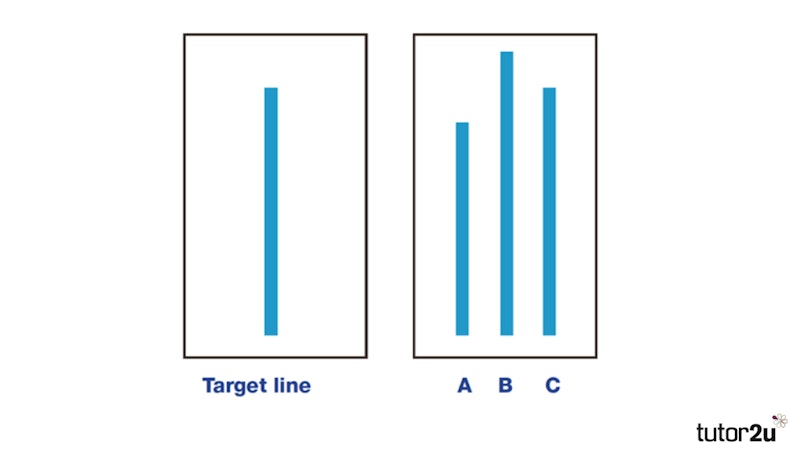
Asch's conclusion was not that people are irrational. It was more unsettling than that: social conformity operates at the level of perception itself. We do not form independent judgements and then decide whether to voice them. We partly perceive the world through the lens of what others appear to perceive. The social default is not a downstream distortion of reasoning. It is upstream of it.
Irving Janis gave this its canonical organisational treatment in his 1972 analysis of Groupthink. Studying the Bay of Pigs fiasco and the Challenger space shuttle decision, Janis identified how intelligent, experienced, well-intentioned teams could produce catastrophically bad decisions because social cohesion suppressed dissent. The features he identified are worth naming precisely: an illusion of unanimity (silence is treated as agreement), direct pressure on anyone who voices doubt, self-appointed "mindguards" who filter uncomfortable information before it reaches the group, and a collective moral certainty that the group's purpose exempts it from normal scrutiny.
Each of these features is a regular presence in educational leadership. I have sat in SLT meetings that were, in formal terms, entirely professional - structured agendas, evidence packs, measured discussion - and where no one said what several people in the room clearly knew needed saying. The silence was not ignorance. It was the social default running exactly as designed, calibrated to the specific hierarchy and interpersonal history of that particular team.
There is a distinctly British dimension worth examining. We prize politeness, deference to seniority, and a deep aversion to confrontation. These qualities are not without value. But they make the social default considerably harder to challenge than in professional cultures where open disagreement is more normalised. The staff meeting where everyone nods does not represent consensus. It frequently represents a social default so well-established that people have stopped registering it.
The Ofsted cycle in England makes this particularly vivid. In the weeks before inspection, enormous social pressure builds to perform the version of the school that the group believes the inspectors want to see. Behaviours that dropped away are revived. Language shifts. Displays go up. The process does not feel like deception from the inside - it feels like preparation. But what it frequently produces is an institution temporarily impersonating its own best self, with the gap between performance and reality carefully unremarked upon. The social default does not just distort individual thinking. It can distort an institution's entire relationship with truth.
The genuine corrective is not a suggestion box or an away-day exercise. It is the deliberate, structural creation of conditions in which dissent carries no social cost. This is hard in any hierarchy and harder in education, where the authority of leadership is bound up with moral mission. But the research on psychological safety - Amy Edmondson's work at Harvard Business School is particularly robust here - is unambiguous: teams where people can raise concerns, challenge assumptions, and voice minority views without penalty consistently outperform those where cohesion is achieved through suppression.
The Inertia Default: The Habit That Became a Policy
Of the four defaults, inertia is probably the most systematically misidentified. It masquerades as wisdom. Continuity feels like evidence. Practices that have been in place for a long time appear, from within the institution, to have been in place for good reasons. Challenging them feels not like updating a policy but like undermining a value. This is the mechanism by which "we've always done it this way" becomes, over time, indistinguishable from "this is how it should be done."

Parrish's definition is precise: the inertia default is the preference for the current state over alternatives, even when the current state is demonstrably worse. The neurological basis is well-established. Loss aversion - the asymmetry by which losses register more painfully than equivalent gains register pleasurably - makes the status quo feel far safer than it is. Change involves the possibility of loss. Staying put also involves the possibility of loss, but that loss is diffuse, slow, and abstract. The inertia default takes the concrete, immediate discomfort of change and weighs it against the hypothetical future cost of not changing. In that contest, inertia wins almost every time.
Aristotle's concept of hexis illuminates the deeper mechanism. Hexis - usually translated as habit or settled disposition - describes the character that emerges from repeated action. Aristotle's point was that we become who we are through what we repeatedly do. Courage becomes second nature through courageous acts. But the mechanism is morally neutral. Institutional cultures also become what they repeatedly do. Practices adopted for specific reasons in specific circumstances become, through repetition, simply what is done. They lose their history. They lose their original justification. And they become, in consequence, extremely difficult to challenge, because there is no longer any articulate rationale to engage with. There is only the fact of long practice.

British secondary education offers examples of this that are almost too obvious to be believed, were it not for the fact that they persist and I have experienced them hundreds of times personally. The fifty-minute lesson period, adopted for administrative convenience a century ago, is now treated in many schools as a pedagogical principle rather than a scheduling convenience. The subject-siloed timetable - a direct inheritance of Victorian university structures - has outlasted almost every educational argument for it. The annual performance management cycle, borrowed from manufacturing contexts where outputs were linear and measurable, is applied wholesale to professional learning that is neither. Ask why any of these exist and you will frequently receive not a rationale but a look. (I still ask and that gets me in ‘good trouble’ like the US civil leader and Congressman, John Lewis, called non-violent struggle!)
What makes the inertia default particularly difficult to dislodge in education is its capacity to impersonate expertise. "We tried that and it didn't work" is the inertia default in its most convincing form. Sometimes this represents genuine institutional memory and deserves serious engagement. More often it represents the memory of a poorly implemented version of a good idea, presented as evidence against the idea itself. The distinction matters, but the inertia default makes it almost impossible to draw from inside the institution.
G.K. Chesterton's famous passage about fences is worth mentioning properly, because it is so often misapplied. He wrote that the person who proposes removing a fence must first understand why it was built. The point is not that fences should never be removed. The point is that you cannot make a sensible decision about the fence until you understand its purpose. The inertia default skips the understanding entirely. It simply retains the fence because the fence is there - which is not wisdom, but its convincing imitation.
"Don't ever take a fence down until you know the reason why it was put up." G.K. Chesterton
The Compound Problem
The four defaults do not take turns. They run simultaneously and they reinforce each other, producing what might be called institutional calcification: a condition in which an organisation becomes structurally incapable of updating on evidence, not through any single failure of reasoning but through the accumulated weight of all four defaults operating in concert.
The typical sequence runs like this. A leader becomes emotionally invested in a particular approach, say a specific model of professional development they championed. The emotional investment activates the ego default: revising the approach would constitute an admission of error, and the self-image of the visionary leader cannot easily absorb that. The ego default then feeds the social default: the leader's public commitment becomes the social norm of the team, and challenge carries an implicit cost that most team members are not willing to pay. Over time, all three reinforce the inertia default: the approach becomes what we do, embedded in structures and schedules and team identities, insulated from scrutiny by the sheer fact of its establishment.
The approach does not need to be failing spectacularly for this to constitute a serious problem. It only needs to be worse than an available alternative that is being prevented from getting a fair hearing. In educational institutions, this is not an occasional failure. It is the operating condition.

The emergence of AI in education from 2022 onwards has provided an unusually clear live example. The evidence about what AI can and cannot do in learning contexts has been shifting rapidly and requires active, ongoing engagement. The emotion default produced both uncritical enthusiasm and reflexive hostility, neither grounded in serious analysis. The ego default locked people into positions staked out publicly in 2023 that cannot now be revised without apparent inconsistency. The social default ensured that institutional cultures around AI were set largely by whoever spoke loudest earliest. The inertia default meant that a large number of schools simply waited, treating inaction as a neutral position, when inaction is, in fact, a choice with consequences.
Seniority amplifies all four defaults. The more positional authority someone holds, the more their emotional responses get treated as institutional priorities, the more their ego investments become team commitments, the more their social preferences define acceptable discourse, and the more their inertia sets the velocity of the whole organisation. This is not an argument against leadership. It is an argument for building structures that specifically counteract the way authority concentrates and amplifies default thinking.
Space, Structure, and the Right Question
Parrish's core argument is that the defaults operate in the space between stimulus and response. They are fast, automatic, and largely invisible. The primary intervention is to widen that space and to have something purposeful to do with it.

This is genuinely ancient wisdom. Epictetus, whose Enchiridion was a manual for this exact problem, put it with characteristic directness:
"Men are disturbed not by the things which happen, but by the opinions about the things." Epictetus
He was not prescribing detachment. He was prescribing examination - the deliberate interposition of scrutiny between what happens and what you do about it. The defaults are what fill that space when scrutiny is absent.
Gary Klein's pre-mortem technique is one of the most practically effective tools for groups. Before committing to a decision, the team is asked to project six months forward and imagine the decision has failed badly. The task is then to explain why. This single inversion - from "will this work?" to "what would have to go wrong?" - disrupts all four defaults at once. It gives emotional investment somewhere to go other than into denial. It licenses the ego to take credit for anticipating problems rather than defending a position. It provides social permission for dissent by making dissent the assigned role. And it surfaces the costs of inertia by making failure concrete and imaginable rather than abstract.
Chesterton's Fence, applied rigorously and honestly, is the specific instrument for the inertia default. The question is not "why should we change this?" but "why does this exist in its current form?" If the team cannot answer that question, that is not evidence the practice is fine. It is evidence that the inertia default has been doing the reasoning.
The question I return to most often, and which Parrish circles in various forms, is this: what would I need to believe if I were genuinely committed to the outcomes I claim to care about? It works because it does not challenge the person's values - it recruits them. It treats the stated commitment to pupils, or to organisational performance, or to strategic integrity, as an ally. And it makes the default visible by exposing the distance between where the default is taking the decision and where the stated values want it to go.
Genuine cognitive diversity - not demographic variety on an otherwise homogeneous team, but actual differences in professional background, theoretical framework, and analytical instinct - is the structural intervention rather than the individual one. It does not produce comfortable dynamics. It does produce better decisions. And it specifically targets the social default by ensuring that the group's norm is not "align with the dominant voice" but "push back on the dominant voice until it has earned alignment."

None of this is easy, and it would be dishonest to suggest otherwise. The four defaults are not weaknesses to be corrected once and filed away. They are persistent features of how human reasoning operates under pressure. The work is not elimination. It is ongoing, deliberate interruption - building the habit of noticing which hand is on the tiller before it has already set the course.
Key Takeaways
1. Name the default before addressing the decision. When a proposal stalls, or a decision feels obviously correct, ask which of the four defaults might be operating. Naming it explicitly is not weakness. It is the beginning of actual reasoning.
2. Build a "what would have to be true?" habit. For any significant decision, specify what evidence would change your position. If you cannot specify it, the ego default is already running the analysis.
3. Make dissent structurally safe. Psychological safety is not a culture initiative. It is a set of specific conditions - pre-mortems, standing challenge roles, explicit invitation to disagree - that ensure challenge carries no social cost. Without those conditions, the social default fills the vacuum.
4. Apply Chesterton's Fence to your own institution. Identify three practices that exist because they have always existed. Ask why they began. Ask whether those reasons still apply. The absence of a satisfying answer is information.
5. Separate emotional response from analytical recommendation. Feel first, then analyse. The sequence matters enormously. The emotion default is not the feeling itself - it is the feeling being mistaken for the conclusion.
6. Watch for the compound. Decisions that feel emotionally important, are publicly committed to, enjoy social consensus, and are consistent with current practice require the most scrutiny, not the least. When multiple defaults reinforce the same position, that is a warning, not a vindication.
7. Ask who benefits from the inertia. Inertia is never neutral. Identifying who benefits from the status quo does not make change necessary. It makes the political economy of the decision visible - and that is where most of the real work happens.
Parrish’s framework is not a self-improvement programme. It is a description of how human reasoning actually operates under the pressures that professional life reliably generates. The four defaults are not aberrations. They are the norm. Which means that good thinking is not a natural state we occasionally fall out of - it is something that has to be constructed, deliberately, against the grain of our own cognitive architecture. That is a sobering conclusion. It is also a useful one. Institutions that understand this stop waiting for better people and start building better conditions. The question worth sitting with is not whether the defaults are running in your organisation. They are. The question is whether anyone has been given permission to say so.
Further Reading
Discover more interesting articles here.