.png)
I want to earn a good living and help other people. Apparently I have to choose.
Say that first half out loud in the wrong room and somebody assumes you've stopped caring about anyone but yourself. Say the second half and somebody else assumes you're about to give away your salary and move into a yurt. Nobody seems to have told either group that both sentences can be true of the same person, on the same Tuesday, without contradiction.
It happens again if you say Britain should look after the people already living here. Say it plainly enough and you'll be filed, instantly, under a heading you didn't choose and don't recognise: closed borders, hostile environment, flag-shagger, pick your slogan. Nobody stops to ask whether you also think people fleeing war deserve sanctuary, because the filing system has no slot for both.
And it happens a third time if you say you value the stability that comes from tradition, from marriage, from a community that keeps its promises to its old people as well as its young ones. Say that and somebody will assume you must therefore be against a teenager getting healthcare that keeps them alive long enough to work out who they are. The two positions have nothing to do with each other. They get bolted together anyway, because bolting them together is easier than asking what you actually think.
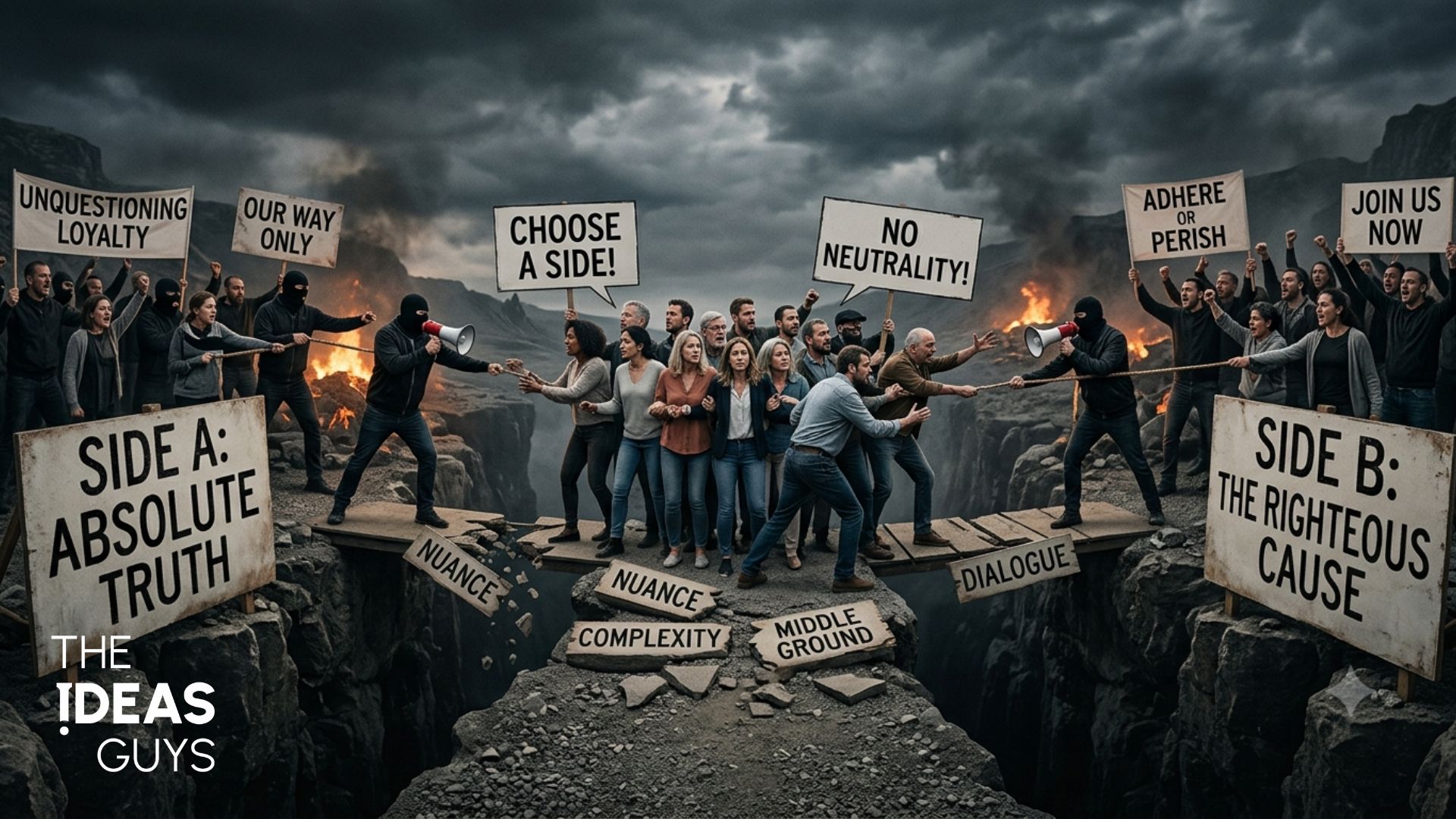
None of this is hypothetical. I've had all three conversations, more than once, in the past year. What strikes me isn't that people disagree with me. Disagreement I can work with, and frankly I want more of it, not less. It's that disagreement increasingly isn't even the mechanism in play. The mechanism is sorting. You get placed on a side before anyone has established what you believe, and then your actual beliefs get quietly edited to fit the side you've been placed on.

Watch it happen in a comment thread some time, if you can bear it. Somebody posts an opinion that's genuinely mixed, genuinely considered, maybe even genuinely boring in how reasonable it is. The first reply doesn't engage with the opinion. It engages with the imagined tribe the opinion supposedly reveals. "Typical," someone writes, or "sounds like a [insert label]," and from that point on, the actual content of the sentence is irrelevant. The label has been applied. Everything that follows in that thread will be a defence of, or an attack on, the label, not the sentence. Nobody asked the person what they meant. Nobody needed to. The sorting had already happened, and it happened faster than the reading did.
This piece is an attempt to work out why that keeps happening, whether it's an accident, and what, if anything, can actually be done about it.
The tyranny of two sides
I've written before about the pull of the binary when it comes to smartphones and screens (The Digital Family), and about the comfort of following the herd rather than standing apart from it (Sheeple People). Both of those pieces treated binary thinking mostly as a personal failure of nerve: a reluctance to sit with ambiguity when ambiguity is the honest answer. I still believe that. Nuance is effortful. A spectrum asks something of you that a slogan doesn't.
But politics adds a layer neither of those pieces dealt with, which is that somebody, somewhere, tends to benefit when you pick a side and stay there. That's the bit I want to get into here, because "people are lazy thinkers" is true but insufficient. It doesn't explain why the two-camp version of every argument keeps winning against the version that's actually closer to how most people live, which is with a mixture of commitments that refuse to sit neatly under one banner.
Most people, in my experience, are not ideologues. They're bundles of specific, sometimes contradictory, often hard-won positions: fiscally cautious and socially generous, patriotic and internationalist, traditional in some things and radical in others. Ask someone what they actually think, in detail, about immigration, or welfare, or gender, or education, and you rarely get a party manifesto. You get a person working something out in real time, weighing a specific case against a general principle. Ask the same person to declare a side, publicly, in a format that rewards brevity, and the nuance gets sanded off within a sentence. Something is doing that sanding. It isn't stupidity. It's structure.

Logicians have a name for the specific move that does most of the sanding. The false dilemma, sometimes called the fallacy of the excluded middle, presents two options as though they were exhaustive and mutually exclusive when in fact a whole range of other positions sit between and around them. It's an old trick, far older than social media, and it works precisely because it's efficient. A false dilemma doesn't need to be argued for. It just needs to be assumed, in the framing of the question itself, and most people will answer the question as asked rather than pause to interrogate whether the question was fair.
It isn't confined to politics, either. I see the same move in schools and organisations constantly: you're either fully behind this change or you're a blocker, you either love the new curriculum or you're stuck in the past, you're either all-in on AI or you're a luddite standing in the way of progress. In every one of those cases, the actual, useful position, the one that says "I support this in principle but I have three specific, evidenced concerns about implementation," gets treated as a form of opposition rather than what it is, which is the only position rigorous enough to be worth having. Nuance doesn't slow decision-making down because it's indecisive. It slows decision-making down because it's doing the work that the binary skipped.
Why your brain prefers a war to a spectrum
Some of the sanding happens before politics gets involved at all, because human group psychology is doing most of the early legwork.
In the early 1970s the social psychologist Henri Tajfel ran a series of experiments now known as the minimal group studies. He took a room of schoolboys who had no prior connection to one another, split them into two groups on a basis so trivial it was barely a basis at all (a coin toss, or a preference for one abstract painter over another), and then asked them to allocate small amounts of money between anonymous members of their own group and the other one. There was no history between the groups, no competition for resources, no ideology, nothing at stake. The boys still favoured their own group and penalised the other one. Tajfel's conclusion, which became the foundation of social identity theory, was that the mere act of being sorted into a group is enough to generate loyalty to it and suspicion of whichever group sits outside it. We don't need a reason to draw a line between us and them. We need almost nothing at all.
"Social groups provide their members with an identification of themselves in social terms. This definition is called social identity... we strive to maintain or enhance our positive social identity, which in turn leads us to evaluate our in-group positively against out-groups." Henri Tajfel
A related, older experiment goes further and shows what happens once that line has real stakes attached. In 1954, the psychologist Muzafer Sherif took twenty-two boys to a summer camp at Robbers Cave State Park in Oklahoma, split them into two groups who named themselves the Rattlers and the Eagles, and let them bond separately for a week before introducing them to each other through a series of competitions. The boys hadn't chosen each other, hadn't chosen the group names, hadn't chosen anything about the arrangement.
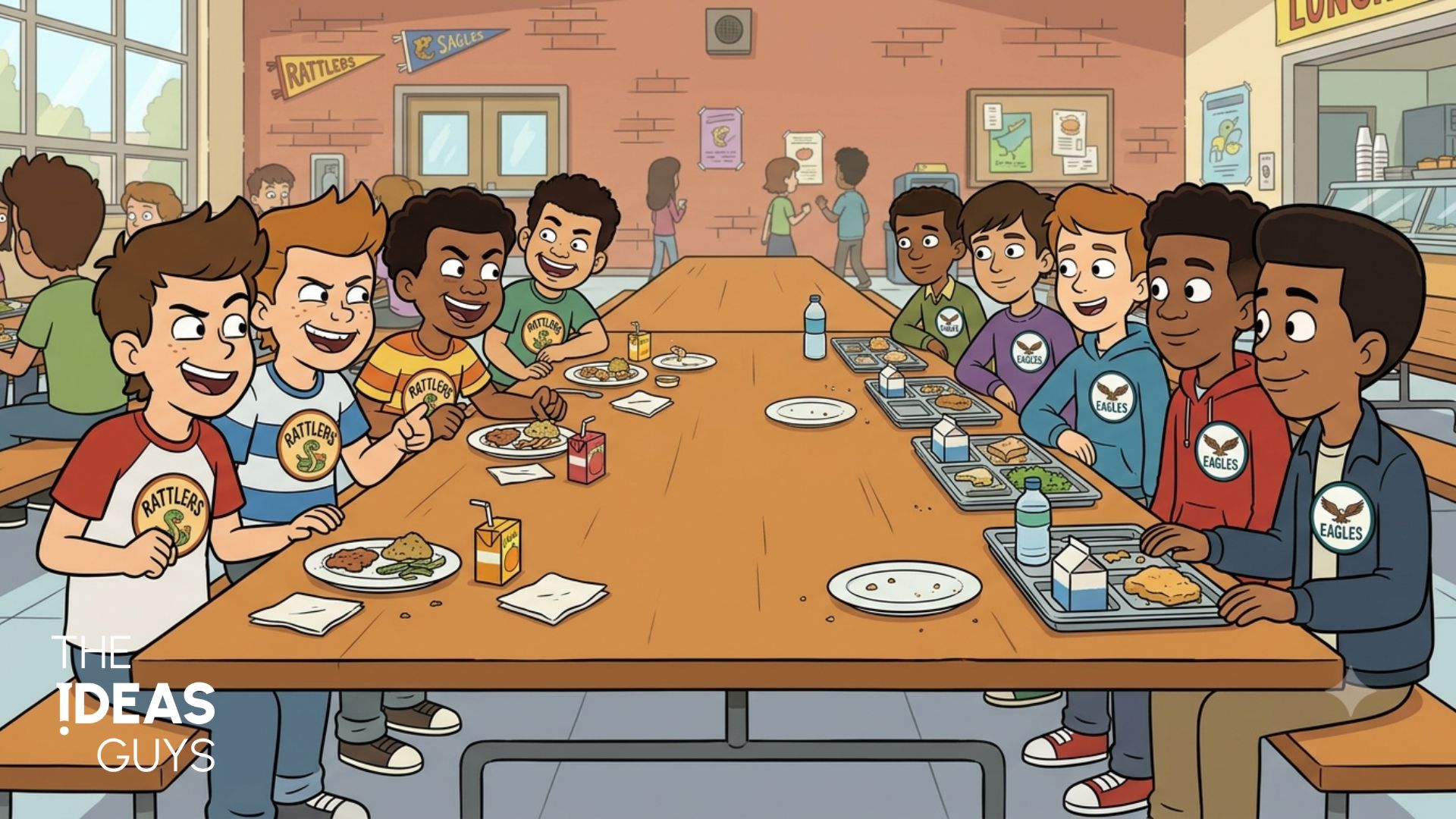
Once the researchers introduced competitive tournaments between the two groups, hostility escalated fast: name-calling, raids on the other side's cabin, cheating accusations, a tug-of-war rope hauled against each other in genuine anger rather than sport. Pleasant contact alone did nothing to calm it. Sherif's team tried simply putting the two groups together for a meal and a film, and the goodwill lasted about as long as it took to walk back to the cabins.
What's genuinely interesting is how the hostility eventually did resolve. It wasn't through mediation, and it wasn't through inventing a third group to unite against, which is the instinctive fix most of us would reach for. It was through what Sherif called superordinate goals: problems that affected both groups and that neither could solve alone. The camp's water supply mysteriously failed, and staff blamed vandals; both groups had to investigate the pipeline together to find and clear the blockage. Later, the truck bringing food for the whole camp got stuck, and it took every boy from both cabins hauling on the same rope to move it. Shared adversity, not a shared enemy, was what dissolved the hostility. By the end of the camp, boys who a fortnight earlier had refused to eat in the same hall chose to ride home together on one bus.
I mention this because it complicates the instinct you and I both share, that division must be the product of somebody manufacturing a common enemy. Sometimes that's exactly the mechanism, and I'll come to that. But Sherif's finding cuts the other way too: what actually heals a manufactured rift is a shared stake in something real, not a bigger, better enemy to unite against. If your working theory of fixing polarisation is "find a common enemy for both sides," you've accidentally proposed more of the disease as the cure. The boys at Robbers Cave weren't healed by a third camp to hate together. They were healed by a broken pipe they both needed fixed.
The politics of the enemy
Group psychology explains how easily the lines get drawn. It doesn't explain why, in public life specifically, the lines get drawn so hard, so often, along an axis that reduces every question to two positions.
The German political theorist Carl Schmitt offered an answer in 1927 that I find genuinely useful, even though Schmitt himself is not a comfortable figure to cite (he later lent his thinking to the Nazi state, and that context matters and shouldn't be laundered out). Schmitt argued that politics, properly understood, isn't really about policy positions or shared deliberation at all. It reduces, in the end, to a single organising distinction: who counts as friend, and who counts as enemy. Everything else, in his account, is downstream of that sorting.
You don't have to accept Schmitt's grim conclusion, that this is what politics should be, to find his diagnosis of what politics has become uncomfortably accurate. An enemy is a far more efficient organising tool than a policy. A policy needs to be explained, defended, adjusted when the evidence changes. An enemy just needs to be pointed at. Once a movement, a party or a media outlet has successfully cast a group as the enemy, whether that's migrants, the wealthy, "the woke," "the right," landlords, or whoever the target happens to be, it no longer needs to win the argument on the merits. It just needs to keep the enemy visible. Nuance becomes a liability at that point, because nuance is precisely what makes an enemy harder to see.

It's worth being clear that this isn't a trait of one political tradition. Every successful populist movement of the last century, left or right, has organised itself around a version of this move, because the move works regardless of which direction it's pointed in. The specific enemy changes. The mechanism doesn't. That symmetry matters, because it's tempting to read Schmitt's diagnosis as an accusation aimed at whichever side you already distrust. It isn't. It's a description of a tool that's available to anyone willing to use it, which is precisely why so many people, across the entire spectrum, currently feel like the political conversation has stopped being about ideas and started being about which team you're prepared to be seen standing next to.
This is worth being careful about, because it's a short step from here to full conspiracy thinking, and I don't think that's where the evidence actually points. Nobody needs to be sitting in a room deciding to divide the country for this to work. It's closer to an evolutionary pressure than a plan: in an information environment where attention is the scarce resource, the framings that spread fastest are the ones that sort people into friend and enemy, because that's what gets a reaction. Whoever discovers this, whether they're a party strategist, a tabloid editor or a teenager running a political meme account, gets rewarded for using it, whether or not they set out to. The incentive doesn't need a conspirator. It just needs to keep paying out.
The business model of division
That reward structure has a name in the research literature, and it predates social media by decades. The legal scholar Cass Sunstein has spent much of his career studying what he calls group polarisation: the well-documented finding that when people who already broadly agree with each other deliberate together, they don't settle into a moderate consensus. They move further towards the extreme version of the view they started with. Sunstein traced this originally through jury studies and small deliberating groups, long before anyone had a newsfeed: put six people who mildly disapprove of something in a room together, let them talk only to each other, and the group as a whole will typically leave that room more strongly opposed than any individual member walked in. The same is true in the other direction, for approval, for risk tolerance, for almost any shared attitude you can measure before and after. It isn't that people are being lied to in that room. It's that agreement, left unchallenged, has a ratchet effect, because each speaker is subtly rewarded for being slightly more committed than the last person to speak, and nobody in an agreeing room has any incentive to be the one who drags the temperature back down.

What the algorithmic feed does, whether or not anyone designing it intended this outcome, is build Sunstein's echo chamber at a scale and speed no physical jury room or seminar group could ever match, and then optimise it for the single metric that predicts continued attention, which is emotional charge. A post that says "this is complicated and here are four considerations" does not travel. A post that says "these people are destroying the country" does. That isn't a value judgement about the platforms so much as an observation about what happens when you build a system that rewards engagement and then feed it several billion human beings who are already, per Tajfel, primed to sort into tribes at the drop of a coin toss. The room Sunstein studied held six people for an afternoon. The room the algorithm has built holds most of the country, indefinitely, and nobody ever has to leave it to go home for tea.
I'd resist the word "conspiracy" here, deliberately, because I think it actually undersells the problem. A conspiracy can be exposed and dismantled once you find the conspirators. This is worse than that. It's an incentive structure that produces division as a byproduct of pursuing something else entirely, namely attention and engagement, which means it will keep producing division even after every individual bad actor involved has been removed, and even if every platform involved acted in complete good faith tomorrow. Nobody has to want the sorting for the sorting to keep happening. That's precisely why it's so hard to argue your way out of, and precisely why the instinct to look for a mastermind, however satisfying, tends to point you at the wrong villain.
Holding the middle without being mushy
None of this is an argument for splitting every difference or refusing to hold a position. That's a different failure, and it's one I'm equally uninterested in. The answer to "you must pick a camp" isn't "I refuse to think anything," it's "I've thought about this properly, and it doesn't sort into your camp."
John Stuart Mill made the sharpest version of this argument I know of, in On Liberty, nearly two hundred years ago. Mill's claim wasn't that both sides of any dispute are equally right. It was that you cannot actually be said to hold your own position with any confidence until you've understood the strongest version of the opposing one.
"He who knows only his own side of the case knows little of that." John Stuart Mill
That line is doing more work than it looks like it's doing. It reframes nuance as a form of rigour rather than a form of weakness. Wanting to earn well and wanting to help others isn't fence-sitting between two poles. It's holding two things that are each independently true and have never actually been in tension outside of the sorting mechanism that insists they must be. Wanting Britain to look after its own and wanting Britain to be humane to people fleeing war isn't a compromise position invented to avoid taking a side. Both propositions can be defended on their own terms, argued for, adjusted in light of evidence, applied differently to different cases. That's not indecision. That's what actually thinking about something looks like, as opposed to reciting the position you were assigned.
The test I've started using on myself is Mill's, roughly translated: can I state the other side's case well enough that someone who holds it would recognise it as their own? If I can't, I don't yet know what I think. I just know which camp I've been sorted into.

Try it on one of the three positions I opened with. Somebody who thinks Britain should tighten border controls significantly isn't, in the strongest version of their case, arguing out of hatred for anyone. They're often arguing from a real concern about pressure on housing, wages at the lower end of the labour market, or the capacity of local services, concerns that are measurable and worth taking seriously on their own terms, whatever you conclude about them. Somebody who thinks Britain should keep its doors comparatively open isn't, in the strongest version of their case, indifferent to those pressures either. They're often arguing from a view about historic obligation, economic contribution, or the plain fact that most of the pressure on services traces to funding decisions that have nothing to do with immigration at all. Neither of those is the caricature the other side has been handed. Once you can state both properly, you're in a position to actually decide what you think, case by case, rather than reciting whichever slogan arrived first.
What this means for leaders and educators
If you run a school, a team or an organisation, the practical version of this isn't abstract. It shows up whenever a genuinely two-sided question gets treated as though it has one correct camp: screens are good or evil, phonics or no phonics, this curriculum reform or the old system, this technology adopted wholesale or rejected wholesale. I made a version of this argument specifically about smartphones and the same discipline applies far beyond that one issue.
The discipline is this: notice the moment a question gets offered to you as a binary, and ask what's being lost in the collapse. Somebody who says AI in the classroom is either a catastrophe or a solution is asking you to stop thinking at exactly the point where thinking is needed most. The leaders I respect most are the ones willing to say, in public, "I think this is more complicated than that," even when saying so costs them the easy applause of whichever camp was hoping to claim them. That costs something. Nuance rarely gets you cheered. It's worth doing anyway, because the alternative is running an organisation, or raising children, or teaching a classroom, according to positions you were assigned rather than positions you actually hold. (My friend, and recent Edufuturist of the Year, Trudi Barrow, wrote beautifully about nuance in a recent LinkedIn post too that I think you all should read.)
The other practical move is Sherif's, not Schmitt's: when a team or a community is fracturing into camps, look for the shared, concrete problem that both camps need solved, rather than reaching for a bigger enemy to unite them against. It's slower and less satisfying than a rallying cry. It also actually works, which the rallying cry usually doesn't, past the initial rush.

I've watched this play out in a staff room split down the middle over a curriculum change, where the leader's instinct was to give a rousing speech about the resistant minority holding the school back. It would have worked, briefly, and it would have cost her the trust of exactly the staff whose expertise she needed most for the change to actually succeed. What worked instead was naming a genuine shared problem, in that case pupil outcomes that both camps cared about for different reasons, and letting the disagreement about method get resolved by evidence rather than by which faction won the room. Nobody had to lose. That's rarer than it should be, and it's rarer because losing is more dramatic, and drama is what gets remembered as leadership even when it isn't.
Key Takeaways
1. Being sorted into a side happens fast and with less justification than most people assume, and the sorting itself, not disagreement, is often the real mechanism at play.
2. Group loyalty and out-group suspicion can form on almost no basis at all, as Tajfel's minimal group studies showed, which means the lines dividing us are often far more arbitrary than they feel.
3. Shared adversity heals division more reliably than a shared enemy does, so "find a common enemy" is rarely the fix it feels like.
4. Politics that reduces every question to friend versus enemy is more efficient to run than politics that has to keep defending a policy, which is exactly why it keeps winning attention.
5. Online outrage spreads because it's rewarded by engagement-optimised systems, not because anyone necessarily planned the division as an outcome, which makes it harder to dismantle than an actual conspiracy would be.
6. Holding a nuanced position is not the same as refusing to hold a position, and understanding the strongest version of the opposing case is the precondition for actually knowing what you think
Genuinely believing two things that don't fit anyone's camp isn't indecision. It's usually a sign you've done the thinking that the camps were hoping you'd skip. I still want to earn well and help other people. I still think Britain can look after its own and be humane to people fleeing catastrophe. I still think tradition and gender-affirming healthcare have nothing to do with each other and never did. None of that has changed since the start of this piece. What's changed is that I understand a little better why holding all three positions at once keeps getting read as evasion rather than what it actually is, which is the ordinary, unglamorous work of thinking something through properly. The sorting isn't going to stop because I've named it. But I can stop mistaking the sorting for an argument, and start asking, every time somebody hands me a camp, whether I actually agreed to join it.
Further Reading
Discover more interesting articles here.