.png)
Ofsted's renewed inspection framework has been running since November 2025. Schools have had almost a year to get used to it, the five-point report card, safeguarding assessed separately as met or not met, inclusion pulled out as its own standalone judgement. This month, on 1 September 2026, Ofsted added another layer. Inspectors now compare a school's attainment against a group of "similar schools", using a statistical model built with the Department for Education, so that judgements on achievement carry more context than a raw exam-results table.
It is, on the face of it, a reasonable refinement. Nobody wants a school in a deprived coastal town marked against a leafy grammar-adjacent comprehensive as if the two start from the same place. But notice what the refinement actually does. It makes the comparison more sophisticated without changing what is being compared. Attainment, progress, similar schools, better data, same question. The debate about education in England, from November 2025 through to this month's update, has been almost entirely a debate about how we measure. Nobody in that debate has paused to ask what, exactly, we think education is for.
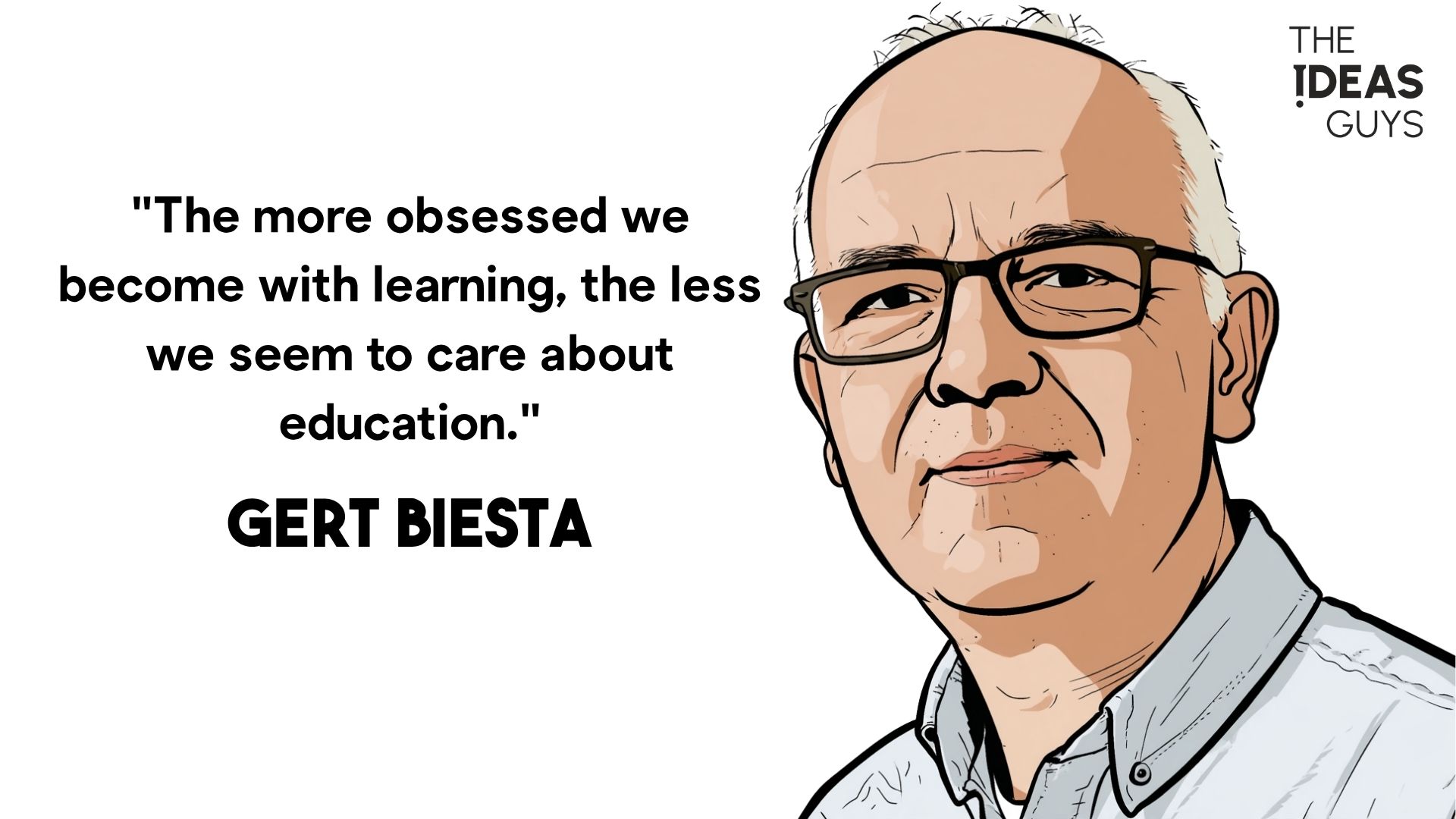
This is precisely the gap the Dutch philosopher of education Gert Biesta has spent two decades naming. Biesta is still working, still publishing, and his argument is not an abstract academic complaint. It is a direct challenge to anyone who leads, teaches in, or sends a child to a school in this country right now. His claim is disarmingly simple: the more obsessed we become with learning, the less we seem to care about education. Those two words, learning and education, sound interchangeable. Biesta thinks the gap between them is where most of what has gone wrong actually lives.

Learnification, and Why a Word Matters
Biesta gave this shift a name: learnification. He defines it as "the transformation of an educational vocabulary into a language of learning", or, in his own more pointed phrasing from the same essay, "everything there is to say about education in terms of learning and learners".
It sounds harmless, even progressive. We stopped saying "pupils" and started saying "learners". We stopped talking about teaching and started talking about "facilitating learning journeys". We built entire inspection frameworks, this country's included, around learning outcomes rather than around the relationship between a teacher and a student. Surely that is more student-centred, not less?
“...the absence of explicit attention for the aims and ends of education is the effect of often implicit reliance on a particular ‘common sense’ view of what education is for. We have to bear in mind, however, that what appears as ‘common sense’ often serves the interests of some groups (much) better than those of others.” Gert Biesta
Biesta's argument is that it is the opposite. Learning, as a word, is fundamentally about the individual. You can learn alone, learn from a video, learn from trial and error with no other person involved at all. Education is not that. Education is "a relationship in which there is guidance towards a goal", not simply a process happening inside one person's head. When you swap the vocabulary of education for the vocabulary of learning, you don't just change some words. You quietly delete the questions that only the word "education" was ever capable of asking: guidance towards what, exactly, and chosen by whom, and to what end.
This is not a semantic nitpick. Once a system talks only about learning outcomes, it loses the vocabulary to ask about content, purpose, and relationship, because those concepts do not fit comfortably inside "outcomes" at all. And once you cannot ask the question, you stop noticing that it has gone missing. Biesta puts the deeper worry plainly: "it also matters what pupils and students learn and what they learn it for", because that is where questions about the kind of citizens we are shaping, and the kind of democracy we are building towards, actually live. A framework fixated on outcomes has no room left for that question. It was never built to ask it.
There is a sharper version of the same worry, and Biesta puts it as a warning rather than an observation. He cautions against assuming that "educational outcomes can and should be measured" as though that were simply a fact about the world, rather than one contestable idea among several, dressed up as common sense because it happens to suit the people currently running the system.
You can watch this migration happen in ordinary school language without needing a philosophy degree to spot it. A parents' evening used to be, at its simplest, a conversation about a child. Increasingly it runs on the vocabulary of a dashboard: flight paths, targets, gap analysis, the language of a spreadsheet applied to an eleven-year-old. No individual teacher decided, in a single staff meeting, to stop talking about education and start talking about learning instead. The vocabulary arrived gradually, through inspection frameworks, through senior leadership training, through leaders who were themselves trained inside a system that had already learnified before they ever took the job. By the time anyone notices, the older vocabulary sounds naive rather than necessary, a bit soft, a bit unscientific, next to the crisp certainty of a progress score.

The Three Purposes, and Why We Only Ever Choose One
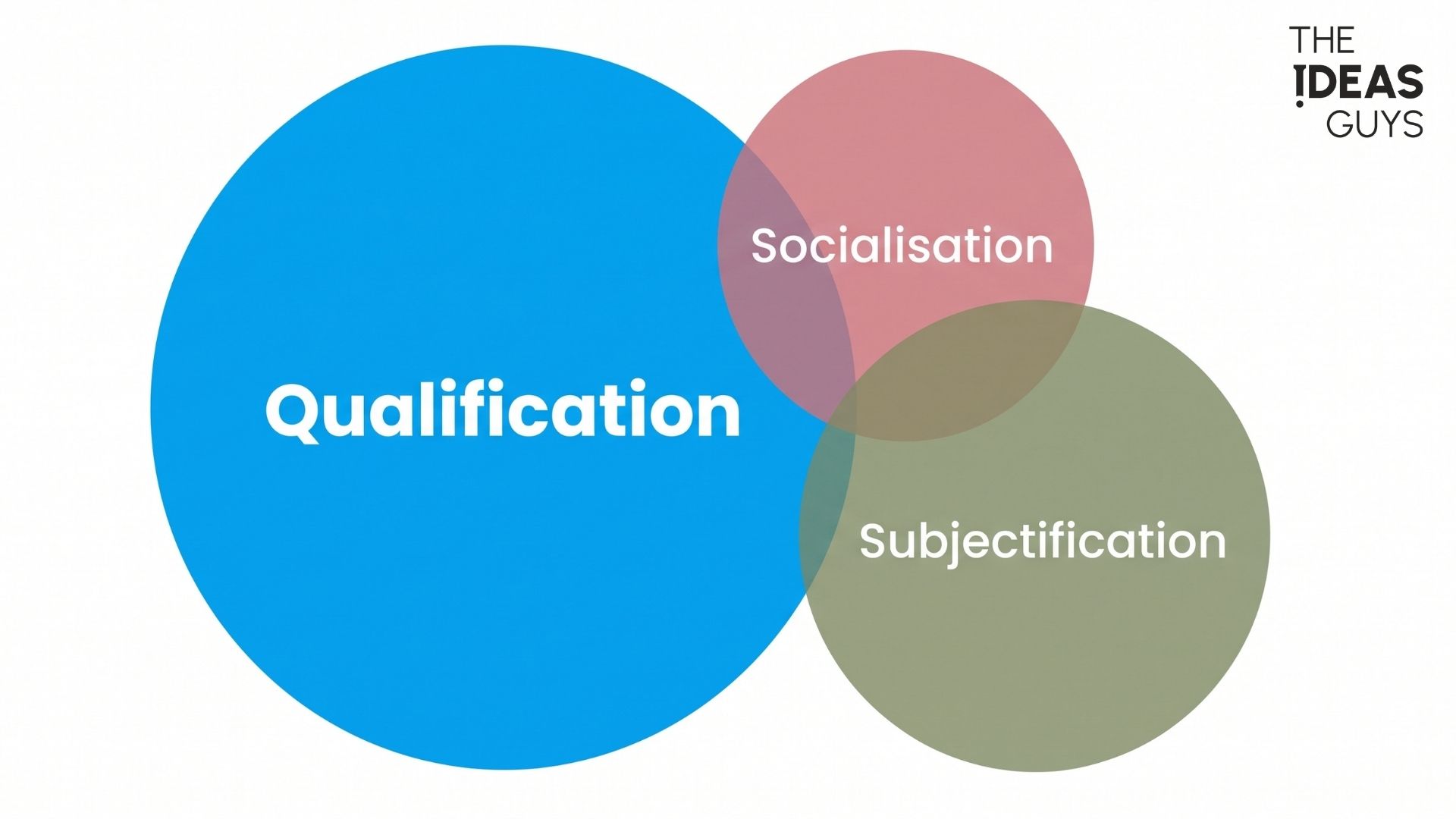
If learnification is the disease, Biesta's alternative vocabulary is the diagnostic tool. He argues that any education worth calling good is doing three distinct jobs at once, and that most of our arguments about schools are really arguments about which one of the three we have quietly decided matters most.
Qualification is the most familiar. It is knowledge, skills, and the certificates that prove you have them. GCSEs, A-levels, the whole apparatus of exam boards and grade boundaries sits here.
Socialisation is how a young person is inducted into existing ways of doing things: cultural, professional, political traditions, the norms of a community they are joining whether they chose to or not.
Subjectification is the odd one out, and the one Biesta cares about most. It is the process by which a young person becomes able to act as a subject of their own life, an independent agent with their own judgement, rather than remaining an object that other people's systems act upon.
Biesta's central complaint is not that qualification matters too much in absolute terms. It is that qualification has been allowed to crowd out the other two almost entirely, while still being described, in policy documents and inspection reports alike, as though it were the whole of what a good education means.
Look at where this month's Ofsted refinement actually sits. The similar-schools attainment model lives inside the achievement judgement, which is now a standalone category in its own right rather than folded into a broader curriculum assessment. That is qualification, made more statistically precise, given its own dedicated space on the report card. Socialisation and subjectification are meant to live somewhere in "personal development and wellbeing", a single category asked to hold everything a five-point scale of exceptional, strong standard, expected standard, needs attention, and urgent improvement was never really designed to hold. Can a young person's growing capacity to think and act as an independent subject be reduced to a single grade running from exceptional to urgent improvement, sitting alongside a wellbeing checklist, without something essential being flattened out of it in the process? Biesta would say the very attempt to grade it is the problem, not just the grade you end up assigning.
None of this means qualification is unimportant, or that measurement itself is the enemy. Biesta is not arguing for an unmeasured, unaccountable free-for-all. He is arguing that a system which can only see qualification clearly, because qualification is what the measuring instruments were built to detect, will eventually mistake qualification for the whole of good education. The other two purposes do not vanish. They simply become invisible to the system that is meant to be evaluating them.
Consider a sixth-form college that has spent three years quietly rebuilding its personal tutoring programme, giving students genuine unstructured time each week to debate, disagree, and think aloud without a mark scheme anywhere in the room. Ask that college's leadership team how the work is going, in Biesta's terms, and they will have a rich, specific answer about subjectification: students who have learned to hold an unpopular position under scrutiny, who have got better at knowing their own minds. Ask Ofsted the same question, filtered through the current framework, and the honest answer is that the framework has no clean category for it. It will surface, if at all, as an anecdote inside personal development and wellbeing, sitting beside attendance figures and safeguarding logs, competing for the same single grade. The work is real. The instrument built to see it is not.
Weak Pedagogy and the Beautiful Risk
There is a second Biesta text worth bringing in here, because it explains why he thinks subjectification cannot simply be added back into the system as another target to hit. In The Beautiful Risk of Education, published in 2014, Biesta makes the case that real education is inherently risky, and that most contemporary policy is designed to squeeze that risk out wherever it finds it.
He borrows a line from W. B. Yeats to make the point vivid: "education is not about filling a bucket but about lighting a fire". A bucket is safe. You know exactly how much water goes in, and it stays where you put it. A fire is not safe in the same way. It can catch, spread, surprise you, go somewhere you did not plan for. Biesta's claim is that genuine education has to behave more like the fire, because a student who has become capable of independent thought and judgement is, by definition, no longer fully predictable or fully controllable, and that unpredictability is not a design flaw. It is the entire point.
This is what he means by education as risk. Biesta argues that students are not to be treated as "objects to be moulded and disciplined, but as subjects of action and responsibility". An object can be shaped precisely and its outcomes forecast in advance. A subject, someone capable of genuine independent judgement, cannot, because independent judgement that was fully predictable in advance was never really independent at all.
This is also why Biesta calls for what he terms weak pedagogy, as opposed to a stronger, more secure, more standardised, more risk-free version of education that current measurement culture keeps pulling us towards. Weak pedagogy accepts that teaching is "slow, difficult, insecure, unpredictable, and full of risks and uncertainties", and treats those qualities as evidence that education is happening, not as evidence that something has gone wrong and needs tightening up. A framework optimised entirely for certainty, consistency, and comparability between similar schools is, on Biesta's account, optimised against the very thing that makes subjectification possible in the first place.
None of this is an argument against structure, safeguarding, or accountability, and it would be a mistake to read it that way. It is an argument that structure has a ceiling. Past a certain point, more structure does not produce more good education. It produces more compliance, more qualification, and a quieter, harder-to-notice erosion of the conditions subjectification actually needs to happen at all.
There is a useful test here for any policy, however sensibly intentioned. Ask whether it reduces the range of genuinely unpredictable things a student might say, do, or become as a result of an interaction with a teacher. A scripted lesson plan, followed to the letter, reduces that range. So does a marking policy that only rewards the answer the mark scheme anticipated. Neither is necessarily wrong in isolation, both can serve qualification perfectly well, but each one, multiplied across a school day, a school year, a whole educational career, quietly narrows the space in which a young person might surprise the adults around them by thinking something nobody planned for. That narrowing is the cost Biesta wants us to notice. It rarely shows up on any dashboard, because dashboards were built to track the things that stayed inside the plan, not the things that escaped it.

What Leaders Are Actually Optimising For
It would be easy to read all of this as an argument that inspection itself is the villain. That is too simple, and probably unfair to the people currently redesigning it. The renewed framework, and this month's further refinement to it, are genuine attempts to respond to real, well-documented problems with what came before: a single word grade that flattened enormous complexity into one label, a system many school leaders experienced as punitive rather than developmental, and mounting evidence, including formal legal challenges from within the profession, that the old approach was corroding staff wellbeing on a scale nobody could keep pretending was incidental.
The new report card, the standalone inclusion judgement, the explicit staff wellbeing assessment sitting inside leadership and governance, these are not nothing. They represent a genuine, if partial, attempt to widen what gets looked at beyond raw attainment. But Biesta's framework lets us ask a more precise question about even these improvements: which of the three purposes does each of them actually serve? A formal wellbeing assessment for staff is valuable in its own right, but it is not the same as asking whether students are developing as independent subjects. Inclusion as a standalone judgement is a real advance in visibility for a group of pupils historically overlooked, but visibility within a grading system is still, structurally, qualification logic applied to a socialisation problem.
This is where the question becomes genuinely practical for anyone leading a school, a trust, or an education-adjacent organisation right now, not just an academic one. When your improvement plan talks about "raising standards", which of the three purposes is actually being raised? When a curriculum meeting spends forty minutes on assessment objectives and ninety seconds on what kind of person this course is meant to help someone become, that ratio is not neutral. It is a decision, usually made without anyone consciously deciding it. The sector's own scepticism about how far any of this genuinely changes the underlying picture, visible in surveys of school leaders' confidence in the new arrangements, suggests plenty of people closest to the work already sense that refining the measurement has not yet resolved the deeper question underneath it.
The same test applies well beyond schools. Any organisation that trains, onboards, or develops people, a corporate graduate scheme, a coaching practice, a leadership programme, is running its own quiet version of this trade-off, usually without ever naming it in those terms. A well-designed induction programme qualifies someone for the role. A strong team culture socialises them into how things are done here. Genuine development, the kind that produces people capable of pushing back on a bad decision rather than simply executing it well, is subjectification, and it is consistently the first thing cut when a training budget tightens, precisely because it is the hardest of the three to put a number on in a slide for the board. Biesta's framework travels well outside education for exactly this reason. Wherever an institution claims to be developing people, the same three questions are worth asking, and the same imbalance is worth watching for.

The Question That Won't Go Away
None of this resolves neatly, and Biesta would probably be suspicious of any piece that tried to make it resolve neatly. His project has never been to hand over a five-point plan for fixing education. It has been to keep a question open that measurement culture, however well-intentioned its latest refinement, keeps trying to quietly close.
So the question, restated plainly, for anyone leading in education right now: when you say the words "good education", out loud in a staff meeting or silently to yourself while reading an inspection report, which of the three domains are you actually talking about? Qualification, almost certainly, because it is the easiest to point to and the one everyone else in the room will nod along with. Possibly socialisation, if the conversation has turned to behaviour or culture. Subjectification, the thing Biesta thinks matters most and our current instruments are least equipped to see, is the one most likely to have gone quietly missing from the sentence altogether.
That is not a comfortable place to end. It is not supposed to be. Biesta's whole argument is that comfort, certainty, and measurability are not the goal. They are, if pursued single-mindedly enough, the thing that quietly costs us the goal.
Key Takeaways
- Learnification replaces the vocabulary of education with the vocabulary of learning, and in doing so quietly deletes the questions only "education" was ever able to ask
- Good education does three distinct jobs at once: qualification, socialisation, and subjectification, and most disagreements about schools are really disagreements about which one we have prioritised
- Qualification is the easiest of the three to measure, which is exactly why measurement-driven systems keep mistaking it for the whole of good education
- Genuine education carries risk by design, because a student capable of independent judgement was never going to be fully predictable
- Improving how something is measured is not the same as answering what it is for, however genuine the improvement
- The question "which of the three purposes am I actually talking about" is one every education leader can ask this week, in any meeting, about any policy already on the table
Ofsted will keep refining its model. Similar schools will be compared against similar schools with ever greater statistical precision, and each refinement will be presented, not unreasonably, as progress. None of it will answer Biesta's question, because measurement was never built to answer it. That is a job for the people in the room, not the framework they are being judged against. The fire either gets lit or it doesn't, and no report card has yet found a way to grade that.
Further Reading
Discover more interesting articles here.