.png)
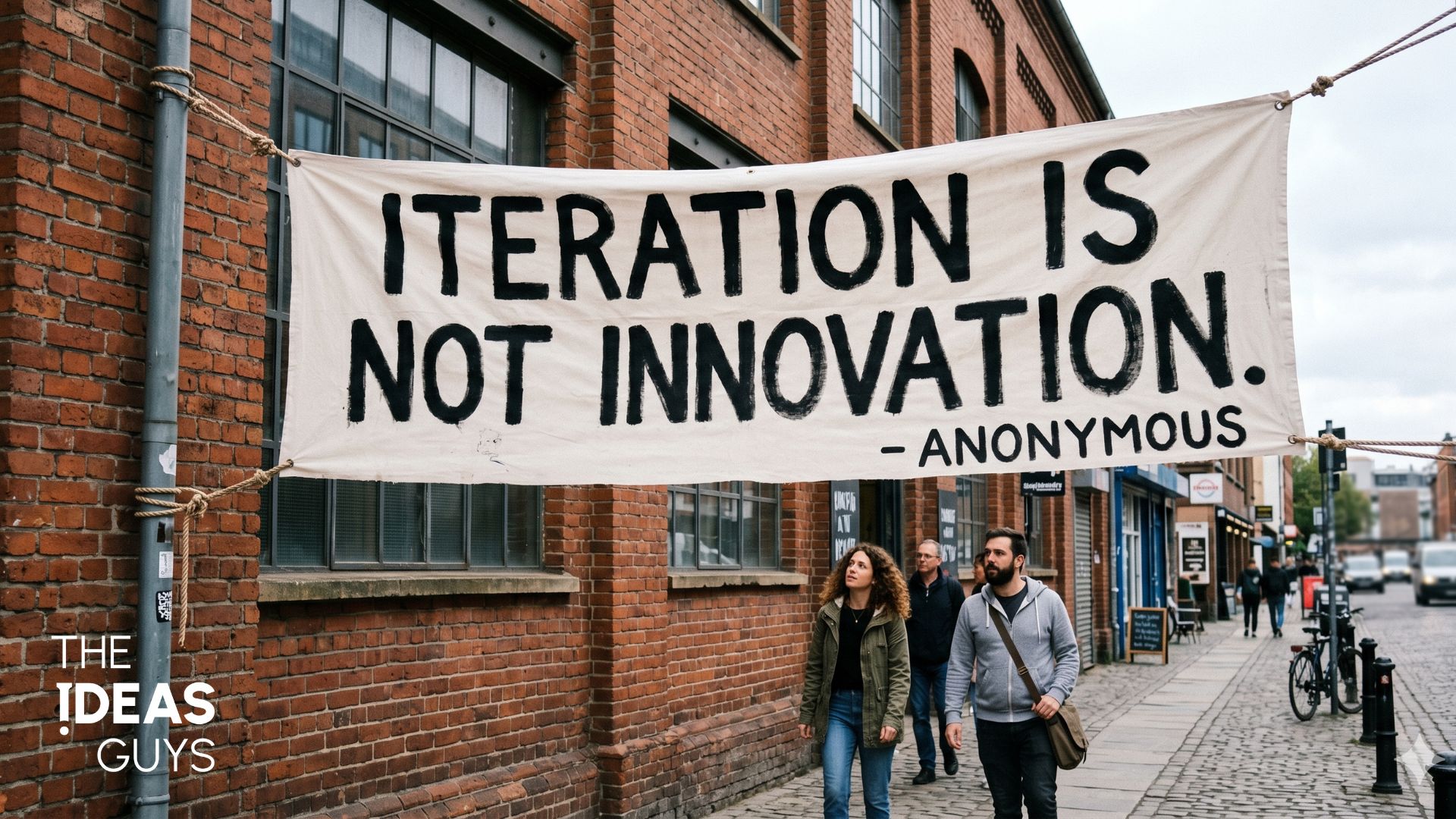
Most of what organisations call innovation is iteration that has put on a lab coat and started using longer words. The vacuum got quieter. The form gained an extra field. The curriculum was renumbered. The app received a fresh accent colour and a launch event. And somewhere in the building, someone wrote the word innovation on a slide and felt rather good about it.
The mislabelling is not harmless. It tells boards and governors that breakthrough is happening when it plainly isn't. It exhausts the people doing careful, genuinely valuable refinement by judging them against a standard meant for something else entirely. And it quietly starves the rare, properly new idea of the patience it needs, because the innovation budget has already been spent on a faster horse with a better paint job.
Innovation and iteration are not the same activity. They are not even the same kind of activity. They run on different logics, carry different risks, fail in different ways, and ought to be judged by different yardsticks. Confusing the two is one of the most expensive habits in organisational life, precisely because it is so rarely noticed.
But - and this is the part worth your Friday - they are not enemies. The most interesting work happens exactly where they cross.

Two different animals
The cleanest way to see the distinction is to borrow it from someone who spent a career thinking about how knowledge actually moves.
In The Structure of Scientific Revolutions from 1962, the physicist and historian Thomas Kuhn drew a line between two states of science. Most of the time, he argued, science is what he called normal science: patient, cumulative puzzle-solving conducted inside an agreed framework - a paradigm. The big questions are settled, the rules are understood, and progress means solving the next well-formed puzzle a little more neatly than the last. Normal science does not go looking for novelty, and when it is working properly, it doesn't find any. Its job is to extend the reach of the existing paradigm, not to overturn it.
That, in any organisation, is iteration. It is honourable, demanding, skilled work. It is also not innovation.
“Normal science, the activity in which most scientists inevitably spend almost all their time, is predicated on the assumption that the scientific community knows what the world is like.” Thomas Kuhn
Then, occasionally, the anomalies pile up - results the paradigm cannot absorb, problems it cannot dissolve - and science lurches into what Kuhn called a revolutionary phase. The rules themselves change. What counted as a good answer yesterday becomes the wrong question today. The frame breaks and reassembles. That is innovation: not a better answer within the system, but a change to the system that decides what counts as an answer at all.
I wrote in the Psychic Dynamite piece about Karl Popper and his principle of falsification. It is worth remembering that Popper and Kuhn spent years disagreeing about exactly the territory we are standing on. Popper believed science advanced through bold conjecture and relentless attempts at refutation - rupture as the everyday engine. Kuhn thought most progress was slow accumulation inside a settled frame, punctuated only rarely by revolution. You needn't referee their feud to take the useful part: there are two genuinely different gears, and a healthy organisation runs in both.
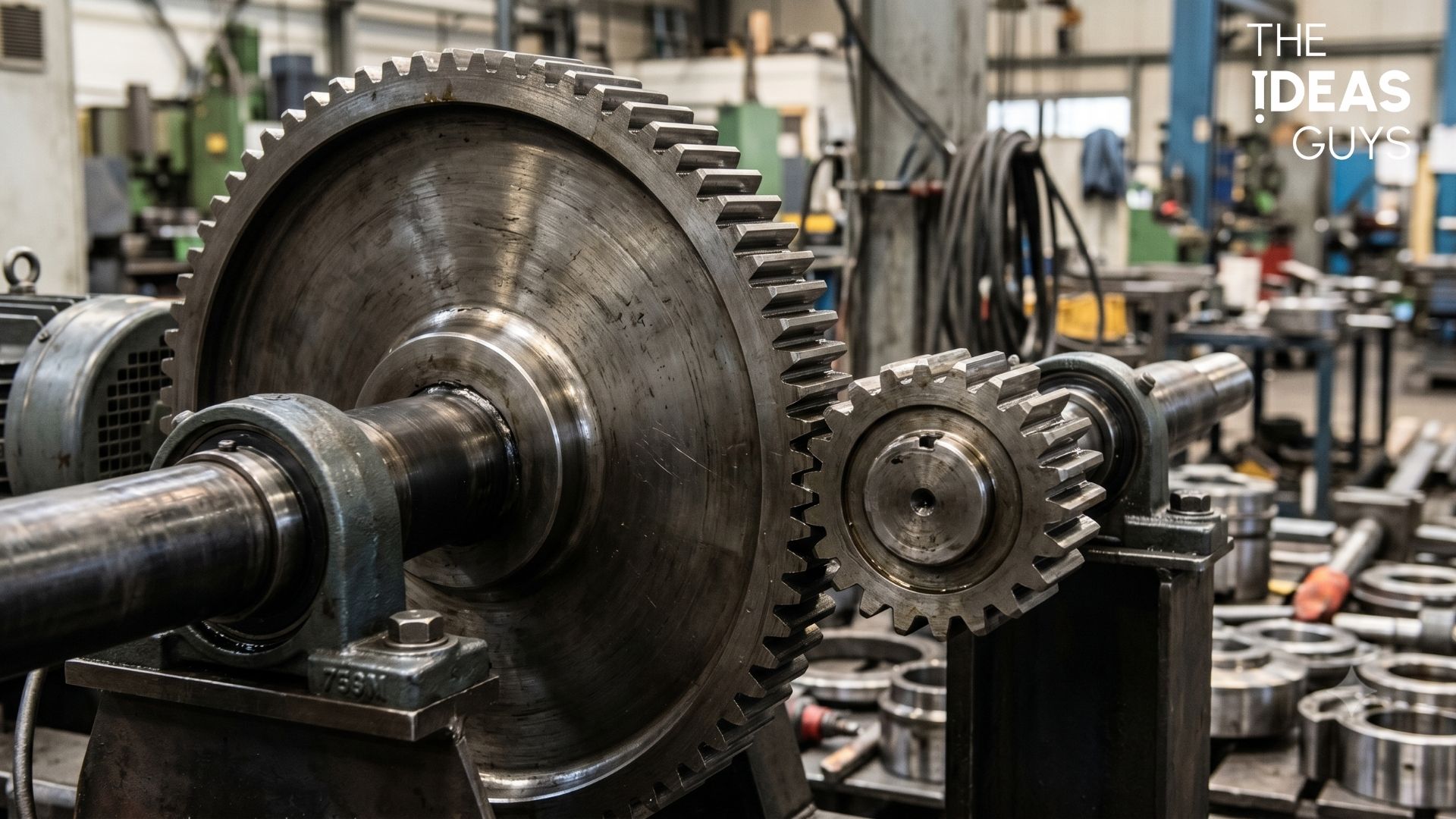
Psychology tells the same story from the inside of the head. The American psychologist J.P. Guilford, mapping what he called the structure of intellect, separated convergent thinking - narrowing in on the single best answer to a well-defined problem - from divergent thinking, which generates many possibilities and is willing to abandon the given framing altogether. Iteration is convergent work: refine, optimise, tighten. Innovation is divergent work: widen, recombine, break. Most of us, and most institutions, are far better at one than the other, and almost none of us are taught when to switch.
“The person who is capable of producing a large number of ideas per unit of time, other things being equal, has a greater chance of having significant ideas.” J.P. Guilford
Why we mistake one for the other
If the distinction is so clear, why is it so routinely fudged?
Partly because iteration is simply more comfortable. It feels safer, it looks busier, and - crucially - it is far easier to measure. You can put a percentage on a faster checkout, a tidier dashboard, a marginally improved retention figure. You cannot easily put a percentage on an idea that has, by definition, no precedent to be measured against. So the work that can be counted gets the credit, and the word innovation drifts towards whatever happens to be visible and quantifiable. We end up rewarding motion and calling it direction.
The economist Joseph Schumpeter saw this trap a century ago. He insisted that genuine innovation meant carrying out new combinations of existing resources - not doing the same thing more efficiently, but assembling something that did not exist before. His image for it has never been bettered:
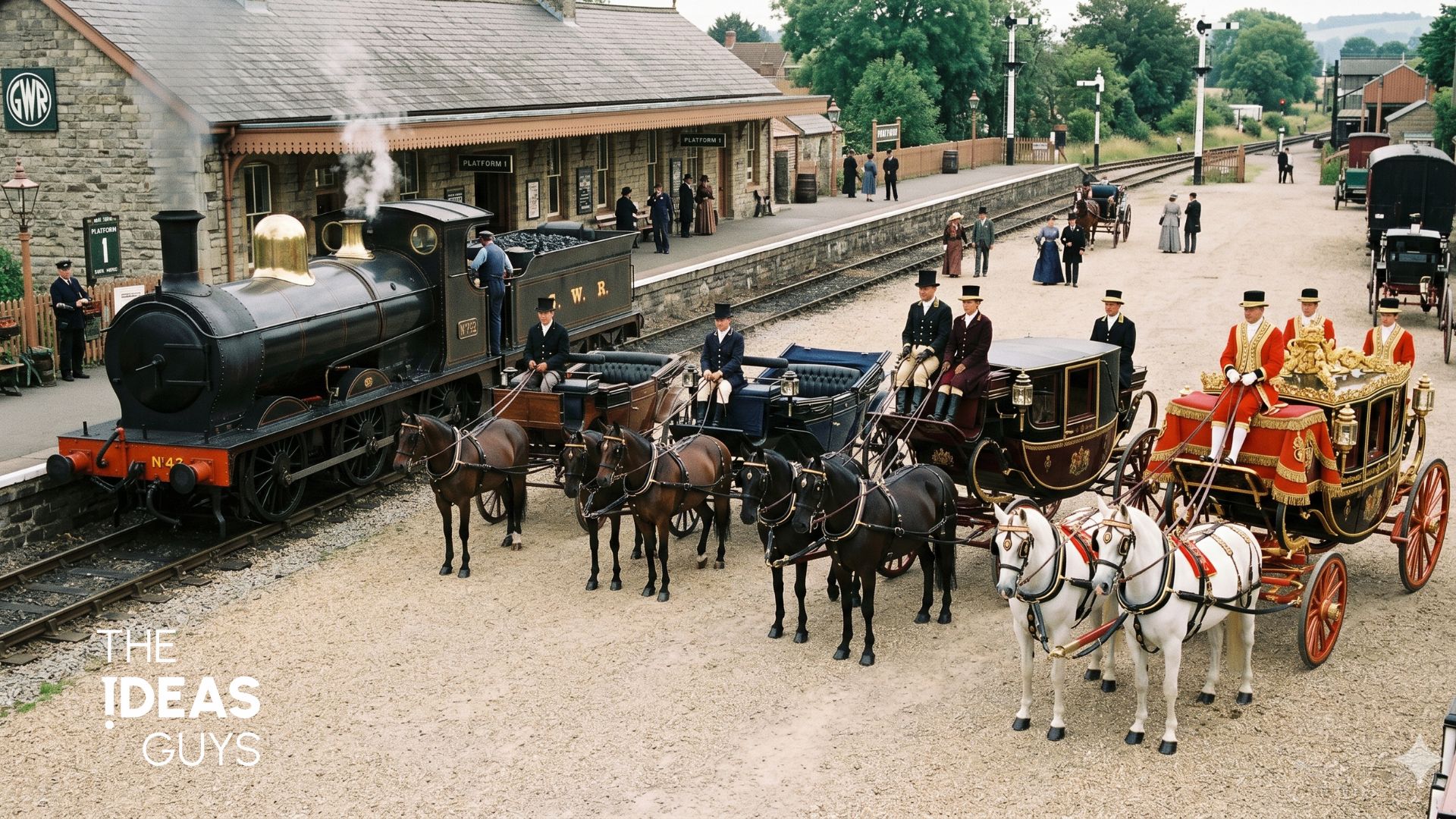
"Add successively as many mail coaches as you please, you will never get a railway thereby." Joseph Schumpeter
That is the whole problem in one sentence. You can iterate the mail coach until it is a marvel of comfort and speed, and you will still be in the coaching business. The railway is a different category of thing. Most "innovation programmes" are, in this sense, a fleet of magnificent mail coaches - and everyone involved is genuinely working hard.
There is no shame in the coach. The error is in the label. When refinement is dressed as revolution, three things go wrong at once. The refiners are held to an impossible standard and made to feel they have underdelivered. The organisation believes it has a pipeline of breakthroughs when it has a backlog of improvements. And the occasional real revolution, when it appears, is throttled by metrics designed for puzzle-solving - asked to show its quarterly return before it has even found out what it is.
Iteration that becomes innovation
It gets interesting here because the line I've just drawn is not a wall. Iteration, pursued obsessively enough and pointed in the right direction, can tip over into something genuinely new. And the most over-told innovation story in Britain happens to be the clearest example of it - provided we tell the parts that usually get left out.
Yes, it's James Dyson. The bagless vacuum cleaner is the stock anecdote of every innovation keynote and the patron saint of the inspirational LinkedIn post. We have all heard the headline: thousands of prototypes, relentless perseverance, a lone inventor proved right. It is so over-used that it has stopped meaning anything. So let's ignore the version everyone knows and look at the bits that actually carry the argument.
First, the "breakthrough" was borrowed. The principle at the heart of the machine - cyclonic separation, using centrifugal force to fling dust out of the airflow - was not conjured from nothing in a moment of genius. It was an industrial technique decades old, used in sawmills to pull sawdust out of the air. James Dyson encountered the idea not while dreaming of vacuum cleaners but while running an earlier venture, the Ballbarrow, where a cyclone tower was installed to collect powder-coating particles in the factory. The famous innovation began as a piece of unglamorous manufacturing housekeeping. In Schumpeter's exact sense, it was a new combination: an old principle carried across a domain boundary into a place no one had thought to put it.
Second, the iteration was not a charming detail - it was the entire substance of the work. Borrowing the principle took an afternoon's insight. Turning it into a machine that actually worked took something on the order of five thousand prototypes across roughly five years, according to most sources. This is convergent grind of the most punishing kind, and it is where the value was actually created.
The engineer-historian Henry Petroski has a phrase for why this matters: form follows failure. In The Evolution of Useful Things, Petroski argues that objects don't improve by chasing some abstract ideal of perfect design; they improve because each version reveals the shortcomings of the last, and the next version corrects them. Failure is not the obstacle to good design - it is the information that produces it. Dyson's thousands of dead prototypes were not the cost of the innovation. They were the innovation, accumulating.
“A good judgment is usually the result of experience. And experience is frequently the result of bad judgment. But to learn from the experience of others requires those who have the experience to share the knowledge with those who follow.” Henry Petroski
Third, and least told of all is that even once it worked, the thing nearly didn't happen. No established British manufacturer would license it, because they made their money selling replacement bags and a bagless machine threatened that revenue. The technology found its first home not in Britain but in Japan, sold there in the late 1980s as a high-priced curiosity, and it was that income that eventually funded the launch of Dyson's own company years later. The breakthrough we now treat as inevitable spent years as a commercial orphan.
So the real Dyson story is not "have a brilliant idea and refuse to give up." It is something far more useful: an existing principle, recombined into a new domain, then dragged into existence by half a decade of brutal iteration, then kept alive by a commercial detour while the market caught up. Innovation and iteration are not sequential stages here. They are braided together so tightly you cannot say where one ends.

Innovation that dies without iteration
If iteration can climb into innovation, the reverse traffic is just as real and rather more tragic: innovation that skips iteration and dies on contact with the world.
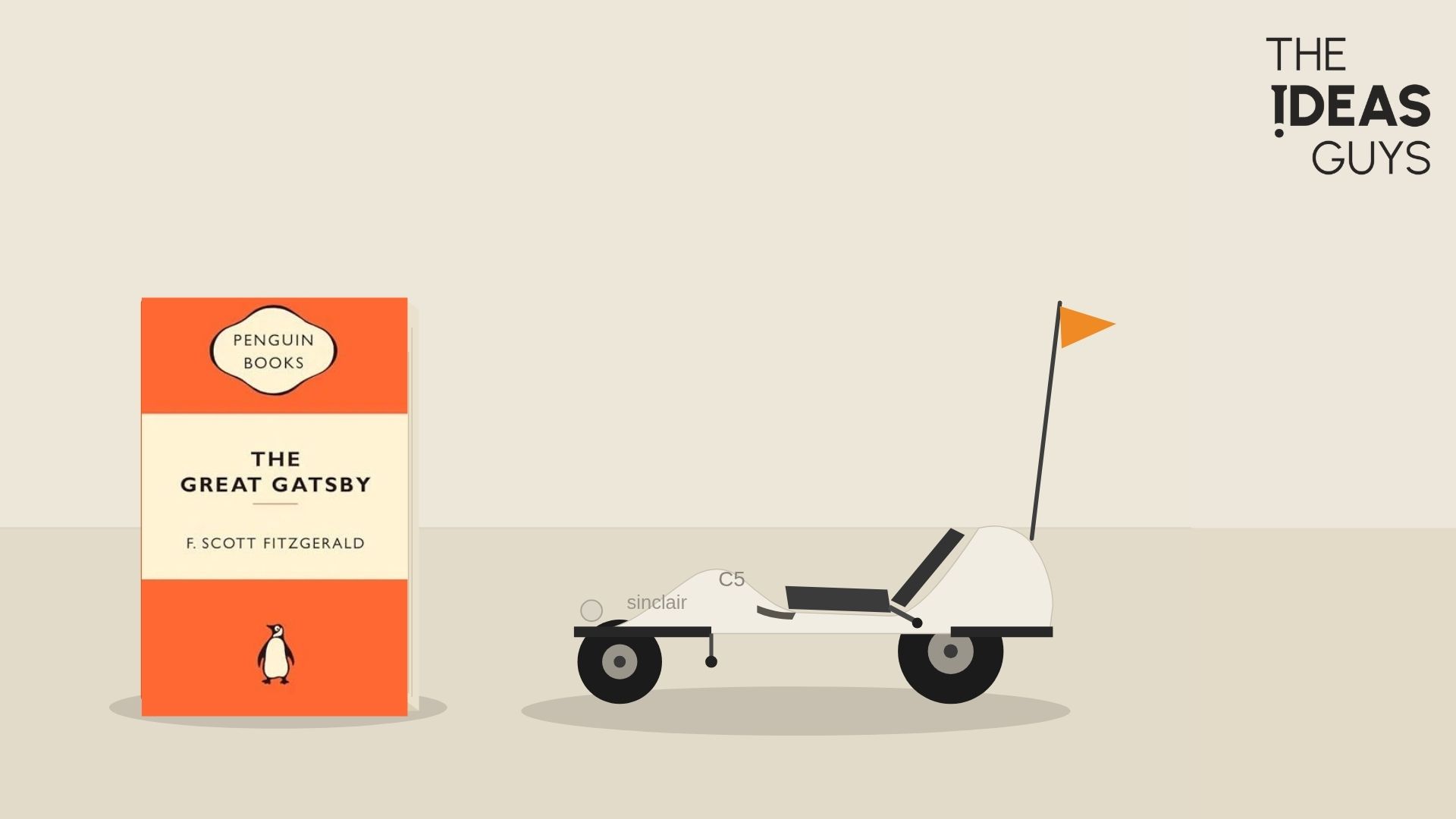
In January 1985, Sir Clive Sinclair - already responsible for genuinely groundbreaking home computers - launched a battery-and-pedal electric tricycle for around £399. Conceptually, it was years ahead of its time: a small, cheap, electric personal vehicle, decades before the rest of the world arrived at the idea. The vision was not the problem. The vision was, arguably, correct.
The execution had simply never met reality. The machine sat low to the ground, leaving its driver at exhaust-pipe height in traffic and largely invisible to lorry drivers. It was open to the full splendour of the British winter. Its battery struggled in the cold, its range was modest, and it laboured on the hills that a great deal of Britain is inconveniently made of. These were not subtle flaws discoverable only after launch. They were the kind of thing that surfaces in the first fortnight of honest testing in a real British town. The Sinclair C5 went to market as a finished revolution rather than a refined product, and it was effectively dead within months.
The lesson is not that the C5 was a stupid idea. It is that a breakthrough is not finished at the moment of invention. It has to be iterated into the world - and the work of doing so is not a lesser, administrative afterthought to the glamorous bit. It is the difference between an idea and a thing people can use.
The sociologist Everett Rogers, in Diffusion of Innovations, gave us the concept that the C5 lacked: reinvention. Rogers found that innovations which actually spread are almost always modified by their adopters and their context as they spread - bent, adjusted and refined to fit how people genuinely live. An innovation that refuses to be reinvented, that arrives insisting the world adapt to it rather than the other way round, tends to stay in the showroom.
For the opposite - a humble iteration that diffused into a genuine innovation - look at Allen Lane and Penguin Books. In 1935, Lane did not invent a new kind of writing. He innovated on format, price and place: good books as cheap paperbacks, priced at sixpence - about the cost of a packet of cigarettes - and sold not only in bookshops but in Woolworths and railway stations, where ordinary people actually were. None of those moves was, on its own, a thunderbolt. Together, iterated and refined around the texture of real British life, they amounted to a genuine cultural innovation: the democratisation of reading. Rogers would recognise it instantly. The idea succeeded because it was reinvented around how people bought and read, rather than demanding they change to suit it.
The C5 had the bolder idea and the worse outcome. Penguin had the humbler moves and changed a country. The difference was iteration - patient, contextual, unglamorous, decisive.
What this means if you're the one in charge
For leaders - whether you run a department, a school, a trust or a company - the practical takeaway is not "do more innovation." It is to stop running the two modes through the same machinery.
Iteration and innovation need different timelines. Refinement can and should be held to quarterly rhythms; breakthrough cannot, and asking a genuinely new idea for its return on investment before it has found its feet is the surest way to kill it while feeling responsible. They need different metrics: efficiency and incremental gain for one, learning and the rate of intelligent failure for the other. They need different tolerances for being wrong - iteration punishes error, innovation requires it. And they need different funding logic, because money budgeted for predictable improvement will always, given the chance, flee from the unpredictable.
The single most common failure I see is one dashboard, one timeline and one budget asked to govern both. Under that regime, iteration always wins, because it can always show its working. Innovation quietly loses every meeting it is in, not because anyone decided against it, but because it could never compete on the terms it was being judged by.
In education the pattern is depressingly familiar. The "revolutionary new framework" arrives, is announced with appropriate fanfare, and turns out on inspection to be last year's framework renumbered and rebadged - iteration sold as transformation, with all the change-fatigue and none of the change. Meanwhile the genuinely effective work - quiet, evidence-informed refinement of how teaching actually happens - goes unbadged and uncelebrated because it doesn't sound new enough to put on a banner. We reward the lab coat and ignore the hi-vis.
In organisations the same dynamic plays out in product roadmaps, transformation programmes and "innovation labs" that produce a steady output of competent improvements and almost no revolutions - because the lab is funded, measured and staffed exactly like the rest of the business it was meant to escape.
The discipline, then, is honesty. Look at the work in front of you and name it correctly. Is this normal science or revolutionary science? A faster coach or an attempt at a railway? Convergent refinement or divergent reinvention? Neither answer is the wrong one. But you cannot resource, measure or protect the work until you have admitted which animal you are actually feeding.
Takeaways
1. Innovation and iteration are different modes, not different volumes of the same thing - refinement within the rules versus a change to the rules themselves.
2. We mislabel iteration as innovation because iteration is safer, busier and easier to measure, so it collects the credit and the budget by default.
3. Stacking improvements never produces a breakthrough on its own - as Schumpeter put it, no quantity of mail coaches ever adds up to a railway.
4. Iteration can become innovation - the real Dyson story is a borrowed principle plus thousands of failed prototypes, not a lone flash of genius.
5. Innovation dies without iteration - the Sinclair C5 had the bolder idea and failed in months because it skipped the patient work of meeting reality.
6. If you lead, govern the two modes differently - separate timelines, metrics, error tolerance and funding - or iteration will quietly win every contest it is in.
The goal was never to choose innovation over iteration, or to sneer at careful improvement in favour of the dramatic breakthrough. Both are essential, and the cleverest organisations are fluent in both and clear about which they are doing at any given moment. The damage is done not by iterating, and not by innovating, but by confusing the two - by demanding revolution from work that was only ever meant to refine, and by starving genuine novelty with the metrics of maintenance. So the next time the word innovation appears on a slide near you, ask the quietly devastating question: is this a railway, or is it simply a very good mail coach in a lab coat? The honesty of your answer will tell you almost everything about what happens next.
Further Reading
Discover more interesting articles here.