.png)

There is a version of reflection that has become entirely safe. It involves a notebook, perhaps a morning routine, possibly a podcast about intentional living. It asks gentle questions. It produces reassuring answers. It confirms, with minor editorial adjustments, the story you were already telling about yourself.
That is not reflection. That is self-narration with better stationery.
Genuine reflection - the kind that has occupied philosophers, psychologists, and serious practitioners of leadership for centuries - is not a wellness practice. It is an interrogation. It asks whether the values you claim to hold are actually the values your behaviour expresses. It asks whether the leader you believe yourself to be is the leader your colleagues experience. It asks, with some regularity, whether you have been wrong about yourself in ways that matter.
Most people, confronted with that version of the task, find something else to do.
This is not a character failure. It is, as the psychological research now makes clear, entirely predictable. And it has serious consequences for individuals who want to lead with integrity, and for organisations whose cultures quietly reflect whatever the person at the top has failed to examine in themselves.

What reflection actually is
John Dewey, writing in How We Think in 1910, offered a definition of reflective thinking that remains more useful than most of what has been written since. Reflection, for Dewey, was not the passive revisiting of experience. It was the active, persistent, and careful consideration of any belief or supposed form of knowledge in the light of the grounds that support it. The key word is active. Dewey was describing a form of thinking that submits beliefs to scrutiny - that asks not just what happened but what does it mean, and how do I know?
“Reflection involves not simply a sequence of ideas, but a consequence - a consecutive ordering in such a way that each determines the next as its proper outcome, while each in turn leans back on its predecessors.” John Dewey
This matters because there is a profound difference between having an experience and extracting anything useful from it. Leaders accumulate experience at a remarkable rate. They sit in hundreds of meetings, make thousands of decisions, navigate conflicts and crises and changes of direction. But experience, unexamined, does not automatically produce wisdom. It produces habits. It produces pattern-matching. It produces, in many cases, an increasingly confident performance of a role that has not been critically interrogated since the early days of the job.
The philosophical tradition that underpins genuine reflection runs much deeper than any contemporary leadership framework. It begins, most pointedly, with Socrates, whose position in the Apology (written by his pupil, Plato) - that the unexamined life is not worth living - was not offered as a motivational slogan but as a serious epistemological claim. Socrates was arguing that without sustained self-examination, we cannot know whether our beliefs are true, our values coherent, or our judgements sound. The examined life is not morally superior because it feels better. It is superior because it is less likely to be built on undetected error.
The essay as a literary and intellectual form was invented by Michel de Montaigne in sixteenth-century France precisely for this purpose. Montaigne was not writing to inform readers about the world; he was writing to examine himself.
"Every man carries the complete form of the human condition within him." Michel de Montaigne
The essai - from the French essayer, to attempt or to test - was a practice of self-interrogation, conducted in public, without the pretence of arriving at settled answers. Montaigne is, in some respects, the first modern reflective practitioner: rigorous, sceptical of his own conclusions, and aware that the self resists honest examination.
Augustine of Hippo, in the Confessions, made the same point with theological urgency. Confessions is not a memoir. It is an extended argument that self-deception is the default condition of the human being, that honesty about oneself requires sustained and uncomfortable effort, and that the gap between who we present ourselves as being and who we actually are is wider, and more consequential, than most of us will admit. Augustine was not modest about his prior failures of self-knowledge. He was precise about them. The precision is the point.
“Free curiosity has greater power to stimulate learning than rigorous coercion. Nevertheless, the free ranging flux of curiosity is channeled by discipline under Your Law.” St Augustine

The self-knowledge gap
The philosophical tradition says we do not know ourselves as well as we assume. The empirical research agrees, with numbers that are worth sitting with.
The organisational psychologist Tasha Eurich, whose 2018 research into self-awareness involved nearly 5000 participants across multiple studies, found that while 95% of people rate themselves as self-aware, independent assessment places the genuinely self-aware at somewhere between 10 and 15%. That is not a small discrepancy. It means that roughly eight in ten people who are confident in their self-knowledge are mistaken about it in ways they cannot detect.
Eurich distinguishes between two types of self-awareness: internal (understanding your own values, feelings, behaviours, and their effect on others) and external (understanding how others actually experience you). Most people who score reasonably on one measure score poorly on the other. Leaders are, in her research, particularly vulnerable to the external gap - partly because their seniority makes honest feedback increasingly rare, and partly because the social dynamics of institutional hierarchy actively suppress it.
Some recent psychological research found that people construct narratives about their motivations that feel accurate but frequently are not. When asked why they made a decision, they produce a plausible explanation. That explanation, however, often bears little relationship to the psychological processes that actually drove the decision. We are largely strangers to our own mental lives, not through any failure of effort, but because most cognitive processing happens below the level of conscious access.
The implication for anyone claiming authenticity as a leadership value is uncomfortable. If self-knowledge is this unreliable, if the gap between espoused motivation and actual motivation is this wide, then what exactly is being expressed when a leader claims to lead authentically? In many cases, the honest answer is: a story. A story about themselves that has not been subjected to serious scrutiny, and which their colleagues - who often see them considerably more clearly than they see themselves - experience as precisely that.

Why we resist it
The psychological mechanism behind the avoidance of genuine reflection was described by Leon Festinger in his theory of cognitive dissonance (where things don’t match up) which I have discussed previously. When we hold two conflicting beliefs simultaneously - or when our behaviour contradicts a belief we hold about ourselves - the resulting discomfort drives us not to examine the contradiction but to resolve it. Usually by reinterpreting the behaviour, finding external causes, or simply not looking.
“The existence of dissonance, being psychologically uncomfortable, will motivate the person to try to reduce the dissonance and achieve consonance. When dissonance is present, in addition to trying to reduce it, the person will actively avoid situations and information which would likely increase the dissonance.” Leon Festinger
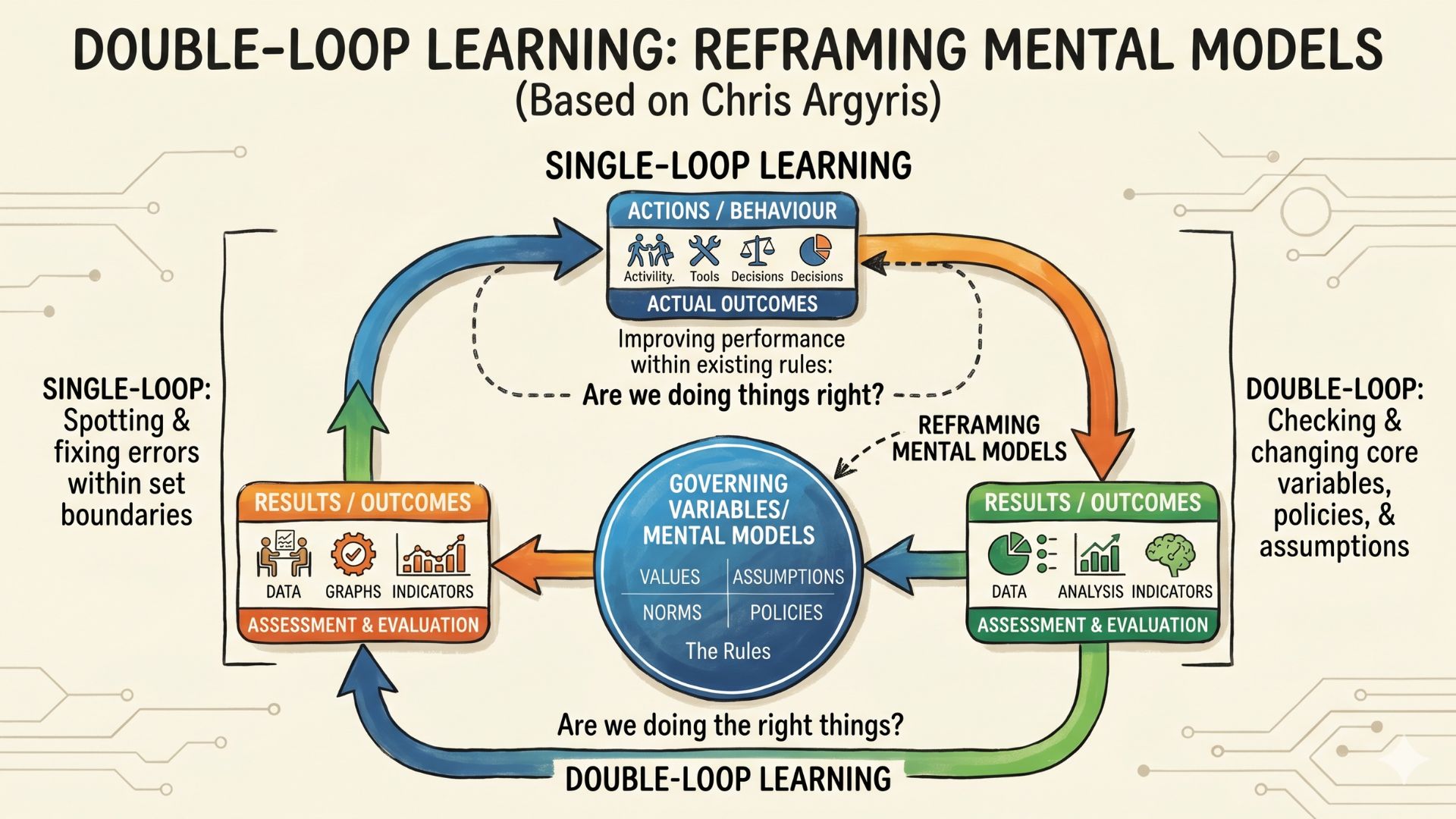
The specific failure mode in professional life was mapped with considerable precision by the organisational theorists Chris Argyris and Donald Schön, whose concept of double-loop learning is one of the most practically important ideas in the leadership literature that almost nobody actually uses.
Argyris and Schön distinguished between two types of learning. Single-loop learning adjusts behaviour in response to outcomes: something didn't work, so you try a different approach. This is the learning that organisations are reasonably good at and that professional development programmes almost exclusively address. Double-loop learning is different. It asks not just what should I do differently? but what assumptions, values, or beliefs led me to do what I did? It interrogates the governing variables underneath the behaviour, not just the behaviour itself.
The reason double-loop learning is rare is not that it is technically difficult. It is that it is psychologically threatening. To engage in it seriously is to entertain the possibility that your assumptions are flawed, that your values are less coherent than you believed, or that what you have presented as principled leadership has been, in part, self-interest wearing the clothing of principle. Argyris was particularly blunt about this in the context of senior professionals. The more competent and senior people become, he argued, the better they become at single-loop problem-solving - and the more they develop what he called defensive routines that protect them from the double-loop questions they most need to confront.
He called it skilled incompetence: the capacity, developed through years of professional socialisation, to avoid precisely the kind of learning that would make you more effective, while remaining entirely confident that you are being rigorously self-critical.
This is not a niche problem. It is the default operating mode of most experienced professionals in most senior roles. The performance of self-reflection - the stated willingness to receive feedback, the annual appraisal conversation, the team away-day with the section on what can we do better - substitutes for the real thing so seamlessly that the distinction is rarely noticed.
A brief cross-reference is worth making here: if the particular dynamic of role capture interests you - the way sustained institutional pressure gradually colonises personal identity until the person disappears inside the role - that territory was examined in a recent issue (What the Role Requires of the Person). The point that connects to this one is simple: you cannot interrupt role capture without genuine double-loop reflection. The diagnosis is available; this article is concerned with the practice.
The philosophical tradition of inward examination
Human beings are fundamentally self-interpreting animals, as mentioned by Charles Taylor and others. We do not have a ‘fixed self’ that exists prior to interpretation and simply awaits discovery. We are made up, to a significant degree, by the interpretations we make of our own experience, our own motivations, and our own values.
This has a direct and demanding implication. If selfhood is interpretive rather than fixed, then authenticity cannot be a matter of simply being yourself - as though the self were a stable object you could locate and express. Authenticity, for Taylor, is an achievement. It requires the sustained, honest effort to understand what you actually value, to identify where your stated values and your lived behaviour diverge, and to take responsibility for that divergence rather than explaining it away. The authentic self is not found. It is - painstakingly, and with significant discomfort - constructed through honest self-examination.
This connects to what Montaigne understood intuitively and Augustine made theologically explicit: self-deception is not an aberration. It is the obvious tendency, all other things being considered. The effort required to see yourself clearly - not charitably, not harshly, but accurately - takes real, ongoing effort. It does not even reduce with experience. In many cases it increases, because experience gives you more sophisticated tools for constructing flattering self-narratives.
Donald Schön distinguished between reflection-in-action - the thinking that happens during practice, the mid-course adjustments - and reflection-on-action - the deliberate examination of practice after the fact, aimed at understanding what was actually happening, not just what appeared to be happening. Both matter. Neither is the same as the casual review that most professionals call reflection. Schön's reflective practitioner is not someone who thinks about their work. They are someone who systematically interrogates the assumptions embedded in their practice, and who accepts that those assumptions may be wrong.

What genuine reflective practice looks like
There is a practical question underneath all of this, and it deserves a direct answer.
Genuine reflective practice is not a solo activity. This for me is perhaps the most important and most consistently ignored aspect of the serious literature on self-knowledge. The reason is structural because if the central problem is that we construct self-serving narratives and cannot easily detect their self-serving quality from the inside, then the corrective has to come from outside. Not always from a coach whose professional incentive may be your continued engagement! And perhaps not from a mentor whose relationship with you makes honesty costly. It likely comes from what the educational literature calls a critical friend - someone with enough knowledge of your work to challenge it with precision, enough psychological safety in the relationship to do so honestly, and enough independence from your institutional context to avoid the dynamics that make candour difficult inside it.
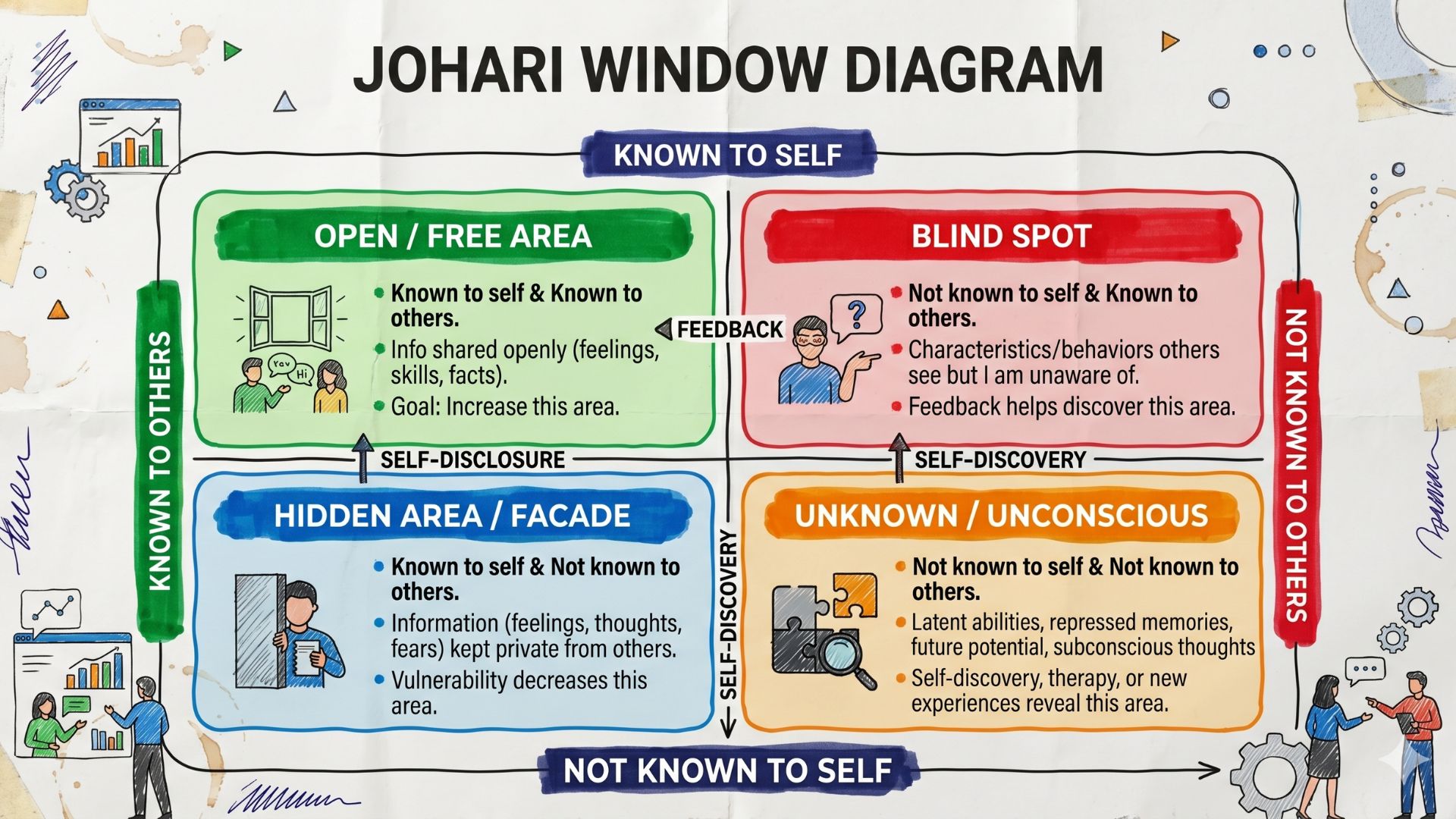
The Johari Window, developed by psychologists Joseph Luft and Harrington Ingham in 1955, remains a useful frame for understanding why this matters. It maps the relationship between what you know about yourself and what others know about you across four quadrants. The arena is what both know; the façade is what you know but others don't; the blind spot is what others see that you don't. Genuine reflection works on the blind spot. And the blind spot is only accessible through other people - specifically, through people who are willing to tell you what they see and whom you are willing to actually hear.
The discomfort that arises when this happens - when feedback from a trusted source contradicts the story you have been telling yourself - is not a sign that something has gone wrong. It is the signal that reflection is working. The appropriate response is not to defend the existing narrative. It is to take the contradiction seriously enough to investigate it.
Schön's reflection-on-action, practised properly, also requires regularity and structure. Not the vague intention to think more carefully. A consistent, time-bounded practice of asking specific questions: What did I assume here that I didn't examine? Where did my stated values diverge from my actual behaviour? What feedback have I received that I have not yet adequately processed? What would someone who sees me clearly say about how I led this week?
These questions are not comfortable. That is, precisely, the point.
Reflection and authenticity - the mechanism
It is worth being direct about the logical relationship between these two things, because the connection is frequently asserted and almost never explained.
Authenticity - leading in a way that is genuinely congruent with your values, rather than performing congruence while avoiding examination - requires self-knowledge. You cannot be congruent with values you have not examined. You cannot correct the gap between who you intend to be and who you are if you have not identified that gap. And you cannot identify that gap through the kind of reflection that confirms the story you were already telling.
To be authentic is not to make a show of seriousness, but to be serious (which is a bit of a bastardisation of another Charles Taylor quote). Seriousness, in this context, means being willing to do the epistemological work - to treat your own self-understanding as a hypothesis rather than a settled fact, and to subject it to evidence.
This is what distinguishes leaders (or humans) who grow in self-knowledge from those who accumulate confidence without a corresponding increase in accuracy. The latter group - and it is probably the larger group - may become more capable over time while remaining fundamentally opaque to themselves. Their authenticity is, in a meaningful sense, a performance; not deliberate dishonesty, but the earnest expression of a self-understanding that has not been tested against reality with sufficient rigour.
The examined life is not the comfortable one. Socrates, who made this claim most forcefully, was put to death for believing it (and how it played out in practice in questioning authority!). The institutional stakes for most of us are considerably lower. But the psychological stakes are real. To examine yourself honestly is to risk finding something you would rather not find. It is to accept that growth requires the willingness to be wrong about yourself, not just about your strategy.
The people who do this - consistently, rigorously, with external challenge and appropriate discomfort - tend, over time, to be the ones whose authenticity is recognised rather than merely claimed. That recognition comes not because they are more confident in who they are, but because they have done the work that makes confidence in self-knowledge earned rather than assumed.
.jpg)
Key Takeaways
1. Distinguish reflection from self-narration. If your reflective practice consistently confirms the story you were already telling about yourself, it is not reflection. It is reinforcement. Genuine reflection submits your self-understanding to scrutiny, not affirmation.
2. Take the self-knowledge gap seriously. Tasha Eurich's research places genuinely self-aware people at 10-15% of those who believe themselves to be so. The appropriate response is not to assume you are in that minority, but to ask what genuine self-knowledge would actually require of you.
3. Understand the difference between single-loop and double-loop learning. Adjusting your tactics is single-loop. Interrogating the assumptions that led to the tactics is double-loop. Most professional development addresses only the former. The latter is where authentic growth happens.
4. Find a critical friend, not a cheerleader. External perspective is not optional in reflective practice - it is structural. The blind spot is only visible to others. The value of external challenge is proportional to its honesty and inversely proportional to the comfort of the relationship.
5. Treat discomfort as signal, not noise. When genuine reflection produces discomfort, that is not a sign to stop. It is the indication that the practice is working - that you have found a gap between your stated self and your actual self that is worth taking seriously.
6. Authenticity is an achievement, not a default. Charles Taylor's framing matters here as the authentic self is constructed through honest self-examination, not discovered by removing external constraints. Claiming authenticity without doing the reflective work is, at best, optimism. At worst, it is performance.
7. Build the practice, not just the intention. Regular, structured, specific questions about your assumptions and behaviour - not vague aspirations to be more reflective. Reflection without structure tends to produce the comfortable version: the one that confirms rather than interrogates.
Somewhere in the history of human and leadership development, reflection was repackaged as self-care - made gentle, made optional, made compatible with the story you already believed about yourself. The serious tradition, from Socrates to Montaigne to Dewey to Schön, always knew it was something else. It’s an ongoing obligation to test your self-understanding against evidence, to accept that you might be wrong, and to do something about it when you are. That is harder, more uncomfortable, and considerably more useful. It is also, in the end, the only version that makes authenticity something more than a well-maintained performance.
Further Reading
Discover more interesting articles here.