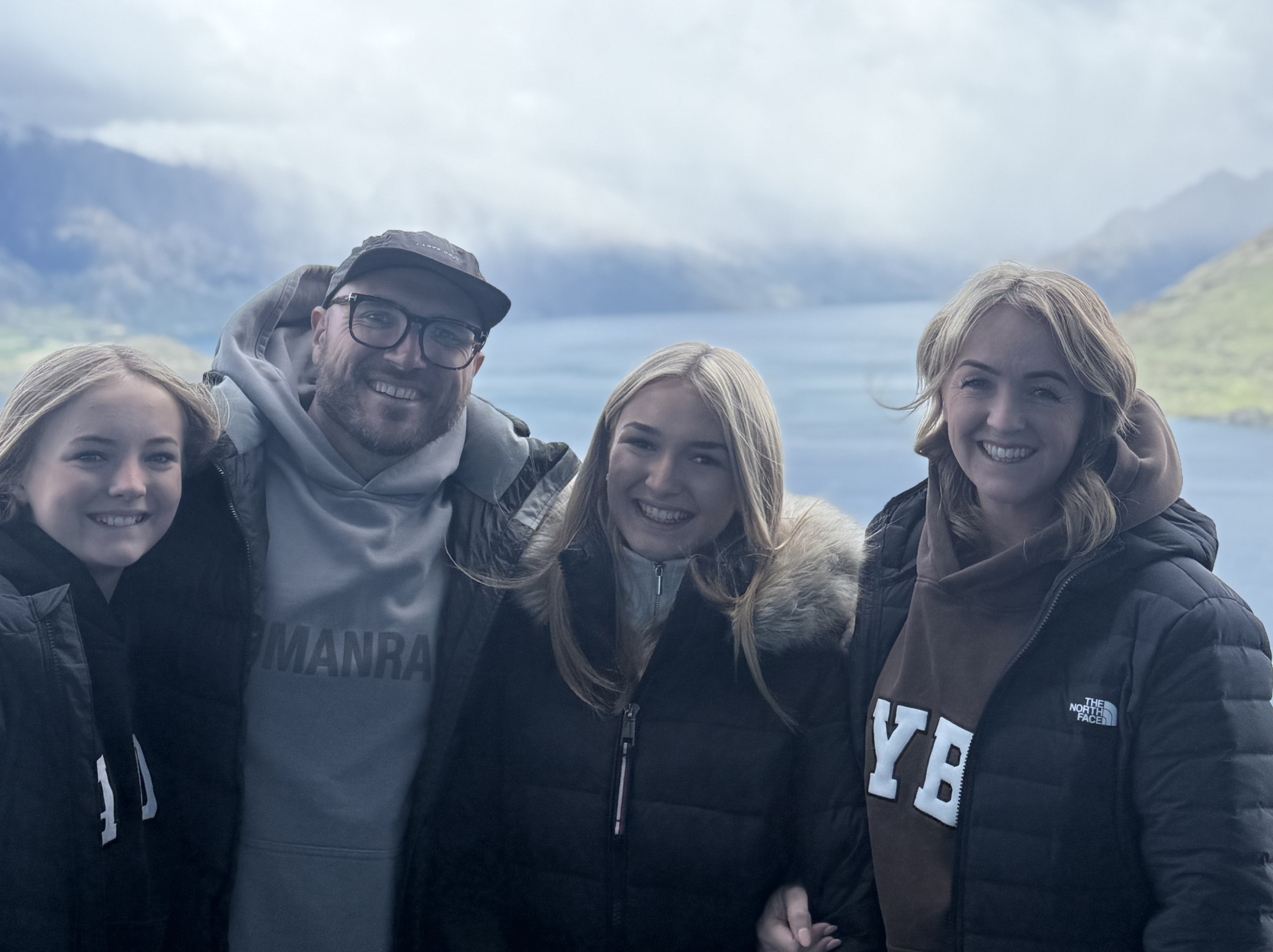
I read less on this holiday than on any trip I can remember. Three weeks away, a bag that left Lancashire with books in it, and most of them are coming home with their spines barely creased. For someone who writes a newsletter built on reading, that felt faintly scandalous for about a day. Then it stopped feeling like anything at all, which is probably the more interesting part.
The shape of the trip matters to what follows, so here it is. Three days in Dubai doing exactly what tourists do in Dubai. Six days in Mount Maunganui with Paul, my best mate of more than thirty years, who moved to New Zealand twenty years ago. Beach, rafting, fire pits, paddle boarding, and long stretches of simply being in the same place as someone who knew me long before I had a job title. Then Queenstown as a family of four, where we did the things you are supposed to do (the Shotover Jet, Milford Sound, the gondola) and regretted none of them. Then three days in Sydney so the kids could take the ‘gram pics of Bondi, Yochi (don’t ask!) and the Harbour Bridge.
I have written about rest before. In A Rest is A Good Change I argued that rest is a strategic asset, that a holiday is an investment in sustained performance, and I booked the next break with something close to smugness. I still stand by a fair amount of that piece. But I came back from this trip with a nagging suspicion that I had made rest sound like servicing a car. Top up the fluids, check the tyres, back on the M6.
The research has an awkward finding for anyone who thinks about holidays that way. If a holiday is fuel, the tank leaks badly. So this is an attempt to answer a question I should have asked first time round. If the benefits of a holiday fade almost as soon as you land, what exactly is a holiday for?

Lots of fun, quickly gone
That heading is not mine. It is the title of a 2010 paper by the Dutch occupational psychologist Jessica de Bloom and colleagues, and it is one of the more deflating titles in academic psychology. They followed 96 Dutch workers before, during and after a winter sports holiday. Health, mood, tension, energy and satisfaction all improved while people were away. Within the first week back at work, they had generally returned to where they started.
A later study of longer summer holidays, averaging 23 days, told the same story with sharper edges. Wellbeing climbed quickly, peaked around the eighth day away, and had returned to baseline within the first week of going back. Length barely made a difference. De Bloom admitted as much in a newspaper interview:
"I was very surprised that the health benefits faded so fast." Jessica de Bloom
Before I get accused of ruining everyone's next booking, two caveats. First, this is self-reported wellbeing, measured with fairly blunt instruments, and nobody is claiming the holidays were pointless. Second, and more usefully, de Bloom's team found that what people experienced while away mattered more than how long they were gone. Pleasure, relaxation, savouring and a sense of control were what seemed to strengthen and extend the effect.
That links to earlier work by Sabine Sonnentag (one of de Bloom's co-authors) and Charlotte Fritz, who in 2007 identified four distinct recovery experiences. Psychological detachment is not thinking about work. Relaxation is low activation, the body coming down off the day. Control is having your time under your own command. Mastery is the surprising one: challenging, absorbing activity that has nothing to do with your job, such as learning a new hobby or climbing a mountain.
Looking back, the trip sorted itself into those categories without any planning on my part. Fire pits with Paul were relaxation. Being on the other side of the world did the detachment for me (time zones are the most effective out-of-office ever invented). Rafting and paddle boarding were mastery, in the loose sense that I was mostly trying not to fall in. The Shotover Jet was mastery for the driver and pure surrender for me. Control was the quiet one: days with no diary, decided over breakfast.
So the research is not saying holidays don't work. It is saying the glow doesn't last. Which means that if the glow was the point, we have been buying the wrong thing.

Rest that has to earn its keep
In 1948 the German Catholic philosopher Josef Pieper published a short book called Leisure, the Basis of Culture. The English edition carried an introduction by T.S. Eliot. It is the most uncomfortable thing I have read about rest, mainly because it caught me out.
Pieper's target was what he called the world of total work, a culture in which only effortful, useful activity counts as valuable and everything else has to justify itself in work's terms. His sharpest line lands squarely on people like me:
"A break in one's work... is still part of the world of work." Josef Pieper
A break exists for the sake of work. You rest so you can go again. That is precisely how I framed holidays in my earlier piece, and it is how most organisations talk about wellbeing: rest as a performance input, justified by its returns. Pieper's point is that the moment rest has to earn its keep, it has already been colonised. Leisure, for him, is something else entirely. It is a receptive, contemplative attitude, a kind of inner silence in which you can take in reality rather than process it. It is closer to attention than to recovery.
Look at how most organisations now talk about wellbeing and you can see total work wearing a friendlier jumper. Wellbeing days are justified by their effect on sickness absence. Mindfulness apps are bought because they might lift productivity. Annual leave is encouraged because burnt-out staff make expensive mistakes. None of that is wrong, exactly, and I have made all of those arguments in rooms full of leaders. But I want to notice what has happened. Rest has been granted permission to exist only on condition that it reports back with results. Pieper would say that is not rest at all. It is maintenance, scheduled by the people who own the machine.
I was in decent company when I got this wrong. Bertrand Russell's In Praise of Idleness, which I quoted at length in that earlier piece, makes the case against overwork brilliantly. But Russell was largely arguing about hours. Pieper is arguing about posture. You can take three weeks off and spend all of them in the world of total work: mentally drafting, mentally optimising, treating the beach as a charging point.
The faith tradition I belong to got there long before Pieper. Abraham Joshua Heschel, the Jewish theologian whose 1951 book The Sabbath has shaped a great deal of Christian thinking too, insisted that the Sabbath is not a rest stop for the working week. If anything, the week exists for the Sabbath. Heschel was clear that it is no occasion for diversion or frivolity. It is instead:
"an opportunity to mend our tattered lives" Abraham Joshua Heschel
Mend, not refuel. Different verb, different purpose. You refuel something so it can carry on doing what it was doing. You mend something because it has been damaged by what it was doing.
Education is a near-perfect case study in the refuel model. Around 466,000 full-time equivalent teachers work in state-funded schools in England, and their rest is set by the calendar. It arrives in prescribed blocks, it is taken when everyone else takes it, and it is widely understood (not least by teachers themselves) as recovery time for the next term. I remember it well. The first few days of the Christmas break went on recovering, sometimes literally in bed, and the last few days went on planning. What sat in the middle was the bit Pieper would recognise as leisure, and it was usually the shortest part. If de Bloom is right, most of the measurable benefit of that block is gone by the first Friday of January. Nobody designed it that way. Nobody has redesigned it either.

Seeing it again
If the glow fades and refuelling is the wrong model, what lasts? My honest answer, three weeks in, is perspective. Not in the greetings-card sense. In the specific, almost mechanical sense of noticing things I had stopped noticing.
Tali Sharot, a cognitive neuroscientist at University College London, and Cass Sunstein (who made an appearance in my piece on polarisation) wrote a book in 2024 called Look Again about exactly this. Their subject is habituation, which Sharot describes as:
"our tendency to respond less and less to things that are repeated or constant" Tali Sharot
Habituation is useful. It stops you being startled by your own fridge. But it is indiscriminate. It dulls the good things (the people you love, the work you once found thrilling) and, more dangerously, the bad ones: the meeting that achieves nothing, the commitment you agreed to three years ago and never revisited, the low hum of over-commitment you no longer hear because it never switches off. Sharot and Sunstein's argument is that the key to dishabituating is change. Break the pattern for long enough and the familiar becomes visible again when you return.
That is what three weeks on the other side of the world does that a long weekend in the Lakes usually can't. It isn't the rest. It's the contrast. Coming back, I can see my own working week with something like a stranger's eyes, and some of it looks odd. (Not all of it. Some of it looks exactly like what I want to be doing, which is its own useful information.)
Then there was being at the top of the mountain in Queenstown. I am not going to attempt to describe it, partly because far better writers have failed and partly because the gondola was VERY high and I was mostly cold. But psychology has something to say about what happens to people in places like that. In 2015 Paul Piff, Dacher Keltner and colleagues published five studies on awe, which they defined as a response to things so vast they transcend our current frames of reference. Their finding was that awe produced what they called the small self: people felt less self-important and behaved more generously. In Piff's own summary, awe stops you feeling like the centre of the world.
I should be honest about the evidence, because it would be easy to oversell. Attempts to reproduce the effect have been mixed, and at least one follow-up found the boost to helpfulness only appeared in people who reported some religious or spiritual belief alongside high openness to experience. Make of that what you will. (As a person of faith, I have my own view.) But the mechanism rings true. Above water well over a kilometre high, my inbox did not feel important, and the projects I had been anxious about fell into a more sensible order. The small self is not a smaller ambition. It is a better sense of proportion.

The friends who knew you before your job title
Six days with Paul did something no amount of scenery could.
C.S. Lewis, in The Four Loves, set friendship apart from the other loves partly by its uselessness. Friendship, he argued, is unnecessary in the way philosophy and art are unnecessary. It has no survival value, but it is one of the things that gives survival its value. He also described the peculiar freedom of real friendship, in which two people meet:
"abroad, on neutral ground, freed from our contexts" C.S. Lewis
Lewis meant it metaphorically. In Mount Maunganui it was literal. Paul does not care what Edufuturists or The Ideas Guy is doing this quarter. He has no interest in my LinkedIn. Paul didn’t meet me first as a consultant, a speaker or anything else with a strapline. He met me as a lad at nine years old. That makes him a kind of calibration instrument. In Paul’s company, the version of me that has built up around work quietly falls away, and what's left is a fairly clear signal of what I actually care about. It is very hard to inflate the importance of a project in front of someone who remembers you back when you had a lot of hair!
There is a research puzzle in this friendship, too. Robin Dunbar, the Oxford evolutionary psychologist, has spent decades showing that friendships, unlike family ties, have:
"a natural decay rate in the absence of contact" Robin Dunbar
Digital contact slows the decay, in his view, but doesn't stop it. Friendships need face-to-face reinforcement. By that logic, a friendship conducted from opposite ends of the planet for twenty years should have quietly faded long ago. It hasn't. I don't think that disproves Dunbar. I think it says something about which relationships are load-bearing. The ones that survive distance are the ones built on something other than proximity.
And that question transfers uncomfortably well to work. Aristotle, whom I drew on in my piece on telic and atelic activity, distinguished friendships of utility and of pleasure from friendships of virtue, the ones grounded in who the other person actually is. The first two dissolve when the usefulness or the fun runs out. The third lasts. I suspect the same taxonomy applies to projects. Which of my commitments would survive three weeks of neglect, and which only exist because I keep feeding them?

Reading less, on purpose
Back to the books that came home unopened.
My habit on holiday is to read voraciously, and I have always told myself this is a form of rest. This time I didn't, and I think the reason is that my head was already full. Arthur Schopenhauer, whom I leaned on in Pierce the Veil for rather different reasons, argued in his essay On Books and Reading that when we read, someone else does our thinking for us, and that a life of constant reading can crowd out the thoughts that would otherwise arise on their own. He was being deliberately provocative (he was a reader of enormous appetite), but the point stands. Input is not the same as thought.
“Consider, rather, that the man who writes for fools is always sure of a large audience; be careful to limit your time for reading, and devote it exclusively to the works of those great minds of all times and countries, who o'ertop the rest of humanity, those whom the voice of fame points to as such. These alone really educate and instruct. You can never read bad literature too little, nor good literature too much. Bad books are intellectual poison; they destroy the mind. Because people always read what is new instead of the best of all ages, writers remain in the narrow circle of the ideas which happen to prevail in their time; and so the period sinks deeper and deeper into its own mire.” Arthur Schopenhauer
In Forming and Framing Ideas by Asking Better Questions I wrote about Graham Wallas's four stages of creativity, and particularly incubation, the period where you step away and let the unconscious do its slow work. Incubation needs empty space. If every quiet moment is filled with somebody else's argument, the mind has nothing to chew on except what it has just been fed.
So I am reframing the unread books as a feature rather than a failing. Three weeks of low input meant three weeks in which my own half-formed thoughts about work had room to surface. Some of them were bad. A few were not. None of them would have turned up between chapters.

Re-entry is the real strategy
If the fade-out research is right, the most important part of any holiday is not the holiday. It is the first week back, because that is when the perspective is sharpest and also when it is most likely to be lost. Habituation does not wait for you to finish unpacking. Within days, the odd things in your working week will look normal again, and the commitments you questioned on a beach will feel non-negotiable.
So the strategic move is to act inside that window, before the inbox writes your priorities for you. For me, that means:
- Reconnecting with a few projects that I really wanted to work on but hadn’t got sign-off for yet;
- Pulling together my learnings from The Ideas Guy to relaunch it in 2027 as an expanded edition;
- Getting a little further in front consistently in my presentation and writing so as not to be as rushed as usual!
- Finding time to develop some long-term business interests that will include my family and some of my friends from around the world (this is really exciting!)
The principle is simple, even if the practice isn't. Decide what you are going to stop before you decide what you are going to start. It is far easier to drop something on the first morning back than in week six, when it has quietly reattached itself to your diary. Treat the things that made your stomach drop when they crossed your mind on holiday as data, not as nerves. Distance is diagnostic.
The research offers two further nudges. De Bloom's group found that working while on holiday has a negative influence on health and wellbeing once people return, which suggests the half-checked inbox does more damage than it feels like at the time. And a growing body of work on holiday frequency points the same way: if the effect fades quickly, regular shorter breaks spread across the year may sustain wellbeing better than one heroic trip. I say that as someone who has just taken a heroic trip and would happily take another. The point is not to stop going away. It is to stop pretending that one long break can carry the rest of the year on its own.
There is an organisational version of this, and it is where I would push leaders hardest. If you lead a school, a trust or a team, the re-entry week is the week to protect, not the week to load with catch-up meetings and launches. The September INSET day packed with new initiatives is the institutional equivalent of meeting someone at arrivals with a stack of paperwork. Whatever perspective your people brought back from the summer, you have just drowned it at the door. A better first day back might ask a single question: what did you notice while you were away that we should stop doing?
And some of your rest should have no purpose beyond itself. No return on investment, no performance justification, no clever framing as strategic. Pieper would say that is the only kind that really counts. I am a slow convert, but I think he is right.
Key Takeaways
- Holiday benefits fade fast, so the glow is not the point. Research by Jessica de Bloom found that wellbeing gains from even long holidays typically return to baseline within the first week back at work. If a break is only fuel, it is a poor investment.
- What you do on a break matters more than how long it lasts. Detachment, relaxation, mastery and control are the experiences that drive recovery. A short break with all four can outperform a long one spent half-checking email.
- Rest that has to justify itself through performance is still serving work. Josef Pieper warned that a break taken for the sake of work remains part of the world of work. Some rest should exist for its own sake.
- The real value of time away is seeing your normal life again. Habituation hides both the good and the bad in familiar routines. Distance and change break that pattern, which is why priorities so often shift on holiday.
- Old friends are a calibration instrument. People who knew you before your job title strip away inflated self-importance. The relationships that survive distance are a useful model for spotting which commitments are genuinely load-bearing.
- The first week back is the most strategic week of the year. Perspective is sharpest and most fragile on return. Decide what to stop before the inbox decides for you, and leaders should protect re-entry rather than fill it.
When I wrote about rest last time, I booked my next holiday as an investment. I am coming home from this one with a different view. The trip was the cheap bit. The flights, the fire pits, the jet boat and the gondola to the top of Queenstown Hill are all paid for and already fading. The expensive part starts now, and it is not measured in pounds. It is the cost of actually changing something while I can still see clearly, before habituation quietly puts everything back where it was. Heschel's verb was mend, not refuel. So here is my question for you, wherever your last break took you. What did you notice while you were away, and what have you done about it since.
Further Reading
Discover more interesting articles here.